
White paper
Introducing EchoAnalyst
How every reviewable Gospel conversation is read, scored and reported, and where we decided AI does not belong.
Get the white paperFree PDF, 26 pages
White paper
How every reviewable Gospel conversation is read, scored and reported, and where we decided AI does not belong.
In short
EchoAnalyst is EchoGlobal's AI reviewer. About a minute after a conversation closes, it reads it, scores it, writes a coaching note, watches it for risk, and turns all of it into reporting no ministry has had before.
A score on eleven ministry skills for every conversation, with a one-sentence coaching note. An alert list in five tiers, with Critical findings sent to your leaders that minute if you want them. A measure of spiritual movement across the whole ministry, and the steps seekers took. Fourteen reports, from one responder's review to the Ministry Health Report your board reads.
It does not talk with seekers, and it does not write a responder's replies. Every seeker is answered by a person. The AI reads the conversation afterwards, and it reports to people who decide.
$100 a month for up to 10,000 analyzed conversations, as little as a penny a conversation. Grow and Multiply include the first 10,000 each month. A ministry that has not signed up gets ten free analyses a month to try it. The reporting in every plan stays as it is.
An admin with billing access turns EchoAnalyst on under Admin, Echo Analyst. Try ten conversations free first if you like.
Add it to your EchoPick your plan and sign up online. EchoAnalyst is included in Grow and Multiply, and an add-on you can turn on from inside your account on Reach.
Sign Up
Part one
Our position
A person answers every seeker. The AI reads the conversation afterwards.
 Read after it closes
The most important question facing online ministry is not whether to use AI. It is where to point it first. Much of the industry is building AI that talks. We started somewhere else.
When a seeker reaches out at midnight carrying grief or doubt, the person who meets them is a trained, praying responder. EchoAnalyst reads that conversation after it closes: it scores it, writes a coaching note, watches it for risk, and finds the patterns no team could see by hand.
Reads and scores every reviewable conversation. Flags crisis and boundary concerns. Finds every Scripture passage shared. Writes the review of a responder, of the whole ministry, and of one seeker's journey across many conversations. Measures movement toward God across thousands of conversations.
It does not have ministry conversations with seekers. It does not write responses on a responder's behalf. It does not make ministry decisions. The Gospel is carried person to person, and the AI serves the people carrying it.
Every future use of AI at EchoGlobal will be measured against the same three tests: the evidence for it, whether it can be undone, and whether a person stays in charge. We would rather be the most trustworthy voice in ministry AI than the loudest.
The vision · Luke 10:2
Millions of people search for hope online at every hour. Our partner ministries answer them in chats, messages, emails and calls, and EchoAnalyst comes alongside the people doing the answering.
Every ministry on Echo, combined.
Until now, a responder could go months, or hundreds of chats, with little feedback, simply because no team has the hours to read them. EchoAnalyst reads every reviewable conversation about a minute after it closes, names what was done well, and offers one thing to work on, around the clock.
A late-night chat from a seeker in Asia gets the same careful read as a conversation during business hours in the United States. New responders grow faster when they hear what to work on this week, not at the next training day.
None of this replaces the person. The heart of the ministry is the responder's Spirit-led compassion and a real conversation between two people. The AI works behind the scenes, after the fact.
The church has always taken up new tools to carry the message further: the printing press, radio, the internet. We take up AI the same way, as a tool for the people doing the work, never a replacement for them.
One standard
Faithfulness, excellence and stewardship: one shared lens, the same for every ministry on Echo.
Every evaluation asks whether the responder stayed true to sound doctrine, kept Christ at the center and presented the Good News clearly. The standard is one rubric that every partner can read, so the technology reinforces the mission and never quietly redefines it.
"Follow the pattern of the sound words." 2 Timothy 1:13
We serve a God of excellence, and how we speak with seekers should show it. EchoAnalyst looks at listening, clarity, depth, the use of Scripture and the flow of the conversation. The point is not perfection. It is helping every responder answer with a little more skill, wisdom and love each week.
"The manifold wisdom of God." Ephesians 3:10
Instead of a team reading thousands of transcripts, the reading happens about a minute after each conversation closes. Leaders get their hours back for discipleship and for developing responders, and nothing a conversation could teach is lost.
"Making the best use of the time." Ephesians 5:16



The need
A careful review takes an hour, and a ministry can hold hundreds of thousands of conversations a year.
Illustration: one dot is one conversation.
A coach might spend an hour on a single transcript. Only a sliver of conversations is ever reviewed, so most responders go weeks without timely, specific feedback.
One reviewer weighs theology, another warmth, another clarity. The feedback is sincere and inconsistent, and progress is hard to see.
With more partners, languages and time zones, a seeker in crisis or a young person in danger becomes a needle in a haystack. In online ministry, a concern found weeks later is often found too late.
This is where EchoAnalyst comes in: not to replace the coaches, but to make sure every conversation is read, against one standard, while there is still time to act.

Part two
How it works
No upload, and no backlog for a person to work through.
About a minute after a responder closes a conversation, the analysis starts on its own, and the reading itself takes seconds. It covers every written channel: website chat, text, email and social messaging. Phone calls are not analyzed yet.
Both sides have to say enough to learn from: one message each way on email, three on website chat, two on every other channel. A shorter conversation is skipped rather than scored unfairly, and a skipped conversation is never billed.
Before anything leaves Echo, names become labels like Seeker #1042, and email addresses and phone numbers become placeholders. The ministry's own numbers and web addresses stay in, so a referral to its own site is recognised. The real details are put back when the result returns.
A large language model reads the whole transcript at once, with the topic and the ministry's approved resources beside it, and returns a fixed structure: a 1 to 5 score on each of eleven skills, an overall score, a summary of how the responder served and how the seeker experienced it, and one coaching note. Two small checks run beside it: one lists every Scripture passage shared, one looks for boundary and personal-information incidents.
The same read screens for crisis, criminal concerns and boundary breaks. Each finding becomes an alert in one of five tiers, whatever the conversation scored, and a Critical one can reach your leaders that minute by email, text or banner.
Every evaluation is kept with its conversation and feeds the reports: eleven that count and compare without another AI call, plus the AI-written Responder Review, Ministry Health Report and Seeker Journey summary.
The rubric
Drawn from the coaching standards of many ministries into one rubric. Eight questions are asked of every conversation, three only when the situation arises.
Listening: did the seeker feel known? Warmth, attention, and their situation reflected back accurately. Engagement: did the responder move the conversation from felt need toward spiritual depth, with open questions and replies short enough to read?
Clarity: simple, organized and matched to the seeker, with jargon avoided or explained. Depth: substance rather than pat answers, going past the surface question to the heart of what the seeker needs.
Gospel focus: did the responder steer toward Jesus and present the Gospel clearly, in a way that fit this seeker and this moment? Sowing a seed counts where a full presentation was not possible. Scripture use: accurate, in context, applied to the seeker's life, and sound in doctrine.
Conversation flow: the right pace for the situation. Crisis gets care first, a curious seeker a natural path to the Gospel, a believer encouragement. Closing and follow-up: a warm, personal close, prayer that fits, and a next step suited to where the seeker is.
Crisis sensitivity, when suicide, self-harm or abuse come up: was the gravity met with pastoral presence and a gentle push toward outside help? Grace-filled truth, when hard truth comes up: was it said in love? Care with minors, when a young person is present: words fit for their age, a nudge toward a parent, and no personal details or ongoing contact. When the situation never arose, the question does not count.
Every question is scored 1 to 5 against written anchors. 4 is the baseline for a responder doing the work well, and it is the most common score. 5 is kept for moments worth training others with, and needs cited evidence. 1 means real harm or a broken protocol.
The overall score is the average of the questions that applied, but a serious failure cannot hide inside a good average. One question scored 1 caps the whole conversation at 3.0; two cap it at 2.5, and three or more at 2.0. The seeker's openness and the responder's effort are scored on their own, beside the skills, so a hostile or silent visitor is seen for what it was.
One conversation
The whole exchange is read together before any score is given, the way a coach would read it.
EchoAnalyst reads the seeker's state, here grief, doubt and a door left open, and sets the context every later score is judged against. It also notes where the seeker started.
Warmth before content. The responder earns the right to go deeper by listening first.
EchoAnalyst records which of the nine Gospel elements were presented. Across a ministry, that becomes a picture of how fully the Gospel is going out.
The passage is recorded as Romans 5:8, even when it is quoted without a reference. Whether prayer was offered, and whether the seeker prayed, are kept as their own data points.
Before any score is given, the whole conversation is read for crisis and special situations. If a minor or someone in crisis appears at any point, EchoAnalyst scores how it was handled and records an alert at the right tier.
Illustration: the conversation is invented.
The new measure
Each conversation lands on one of five points, read from the seeker's own words. Across a ministry it becomes one number you can watch: the share of conversations moving toward God.
The rubric measures the responder. The question every ministry leader carries is about the seeker: did this conversation move them closer to Jesus? Online ministry has answered it with stand-ins, like message counts and session lengths.
EchoAnalyst reads the seeker's own words, their questions, their resistance, their softening, what they say they will do next, and places every conversation on the same five-point scale.
Around that measure sit moments that have never been countable at scale: whether prayer was offered and whether the seeker prayed, whether the responder shared a word of testimony or a full story of faith, which Scripture is actually being shared, and where opportunities were missed.
Missed opportunities fall into five kinds: a Gospel transition not taken, an emotional cue passed over, a prayer moment missed, a deeper question left unasked, and Scripture not applied. Seen across a team, they say what the next training should cover.
A note of humility
No measure can see what the Spirit is doing beneath the surface. Movement records what a conversation shows: the seeker's own words and the steps they say they will take. It is a tool for stewardship, not a scoreboard for souls.
How far it went
Not only whether the Gospel is going out, but how completely, and what seekers did next.
The starting point: every reviewable conversation, read.
Which of nine elements were shared: God's love, sin and brokenness, who Jesus is, the cross, the resurrection, grace, repentance, faith in Christ, and the invitation to respond. Five of them, sin and brokenness, the cross, the resurrection, grace and faith in Christ, make a full presentation.
Six kinds of step are recorded: a salvation prayer, a rededication, a commitment to keep exploring, agreeing to read Scripture, agreeing to attend church, and asking for follow-up. One step is recorded per conversation.
A seeker who prayed to receive Christ. These are the conversations a ministry celebrates, and each Ministry Health Report carries them, in the seeker's own words where they were shared.
Illustration, not a ministry's data.
The seeker's side
Two lenses no online ministry has had at scale: each seeker's starting posture, and the barriers they carry.
EchoAnalyst records where each seeker started, from hostile to already believing, and reads it against movement, so a ministry can see how conversations go with its hardest audiences and not only its easiest. When a conversation is too brief to tell, it says unclear rather than guessing.
It names the barriers a seeker carries, in seven kinds, and whether the responder engaged them. The Seeker Barriers report then shows, with your own numbers, how often seekers move toward God when their real barrier is addressed rather than passed over.
Addressed means the responder engaged the barrier during the conversation, not that it was resolved.
Up to three felt needs per conversation, from grief and loneliness to addiction and church hurt. The seeker's emotional state at the start and at the end, kept apart from spiritual movement. And the kind of conversation it was, from evangelistic to a prayer request, with trolling and spam recognised as their own kind and kept out of the comparisons.
Risk and special cases
Every conversation is read for crisis, criminal concerns and boundary breaks, at 3 AM on Christmas morning as much as at noon on a Tuesday.
Each finding is recorded as an alert in one of five tiers, Critical, Urgent, Important, Awareness and Informational, with a flag for whether an admin needs to act. The alert is recorded whatever the conversation scored, so a high-scoring conversation still surfaces its concern.
Critical is kept for what needs intervention now: a seeker in crisis, criminal activity, or a responder breaking the platform's protective boundaries. The list leaders read first is never buried in routine notes.
Responders can already raise a crisis in the moment, and the leaders a ministry chooses hear about it by email, text or in-app banner. EchoAnalyst backstops every conversation about a minute after it closes, and when it finds something Critical it can send the same kind of alert, to the people and channels the ministry sets.
Minors get their own question in the rubric. Crisis care is scored on four pastoral signs. A referral to the ministry's own sites, numbers and approved resources is recognised, so a good referral is never a false alarm. And a seeker going quiet is not the responder's failure: a complete, caring Gospel presentation sent into silence is scored as the good work it is.
EchoAnalyst only flags. Every intervention stays with trained people, following the ministry's own procedures.
To the leaders your ministry chooses
Guardrails and privacy
We built it to read like a wise, caring senior pastor, and we check it like an accountable elder board.
What your responder seesHannah wrote from hannah@example.com and asked us to call +1 555 0142
What the model readsSeeker #1042 wrote from [email 1] and asked us to call [phone 1]
Your ministry's own numbers and web addresses stay in, so a referral to your own site is recognised.
Illustration: the name, address and number are invented.
Analysis runs on OpenAI's API, with training on our data turned off. Before any conversation is sent, names, email addresses and phone numbers are swapped for labels and placeholders, and the real details are put back only when the result comes home to Echo.
Leaders never see a bare number. Every evaluation carries a written summary of how the responder served and how the seeker experienced it, and one coaching note, readable like a coach's notes.
Names become labels like "Seeker #1042" and "User #88"; email addresses and phone numbers become "[email 1]" and "[phone 1]". Your ministry's own numbers and email domains are left in. Names of other people mentioned inside a message are not replaced. When a seeker asks to be removed and their record is anonymized, their analysis records are scrubbed too.
Only your ministry's admins see the reports. You decide who else may open a single conversation's evaluation, through the View AI Analysis permission. If you use Echo's GraphQL API, your developers can read your own analyses there too.
Calibration
A rubric is not finished the day it ships. Here is what we changed in its first months, and why.
Early scores put whole teams in a narrow band well below where experienced coaches placed them: team averages around 2.6, and most of one ministry's responders between 2.0 and 2.9. The anchors had made 3 the most common score. We rewrote them so that doing the work well scores a 4.
Coaches at a partner ministry showed us a responder who had sent a complete Gospel presentation to a seeker who then went quiet, marked down for not asking follow-up questions. We taught the rubric to recognise a missed chat and to reward that faithfulness.
In one stretch there were 3,676 Critical alerts across 17,587 conversations, about one for every five, mostly seekers sharing their own phone number. We re-tiered the definitions so that Critical means critical.
Score distributions are watched every reporting period, coaches review real evaluations against real conversations, and each correction ships as its own numbered version that can be rolled back on its own. As the system matures, a set of expert-scored conversations will make this a standing test.
Any output is under human authority. If a mentor or leader disagrees with an evaluation, the person's judgment wins. This is a tool for encouragement, not an automated boss.

Part three
What this means for ministry
The same analysis serves every person in the ministry differently.
Today responders hear it through their coach. Every Responder Review has a responder copy to print and hand over, and a ministry can let chosen responders open the evaluation of a conversation. A view of their own comes next. What it carries is already written for every conversation: a strength named specifically, one next step, and best moments recognised rather than lost.
The Responder Review turns hours of transcript reading into minutes of informed mentoring: scores with week-by-week trends, the team average beside them, a comparison with the last period, and the evidence conversations linked from its key findings. The Training Plan report says what to train on next, and who needs it most.
The Ministry Health Report answers the questions boards and directors actually ask. Is the Gospel going out fully? Are seekers moving toward God? Where is the risk? Who needs support, and who deserves recognition? It even checks the outcome each responder selected against what EchoAnalyst read in the same conversation.
Each Ministry Health Report carries the professions of faith, the praise reports and the seekers' own words worth telling: found by AI, told by people. A Seeker Journey shows one person's whole path across many conversations.
What you get
Prayer. Scripture Impact. Seeker Barriers. Harvest. Crisis & Safeguarding. Training Plan. Open any report to see a sample.
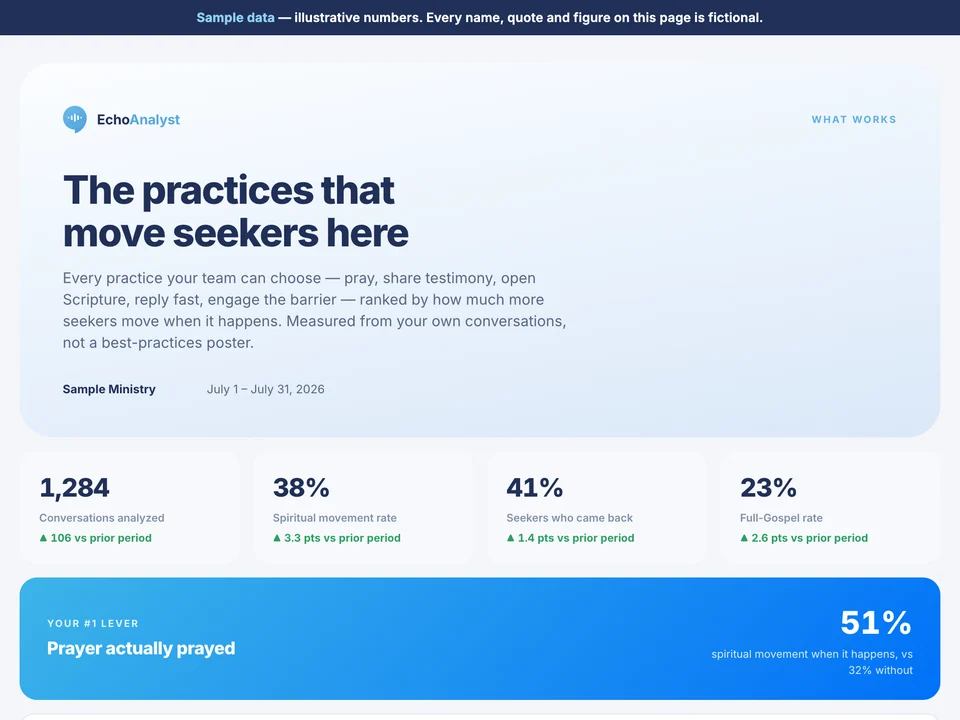 What WorksWhich practices actually move seekers here, ranked by measured lift?
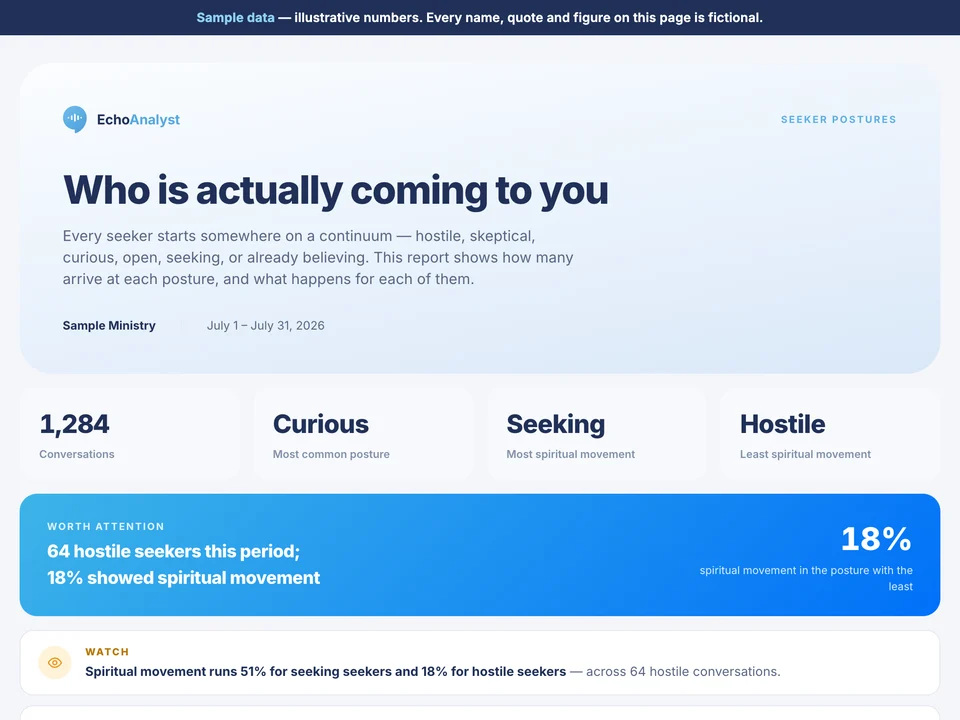 Seeker PosturesWhere do our seekers start, and what happens for each posture?
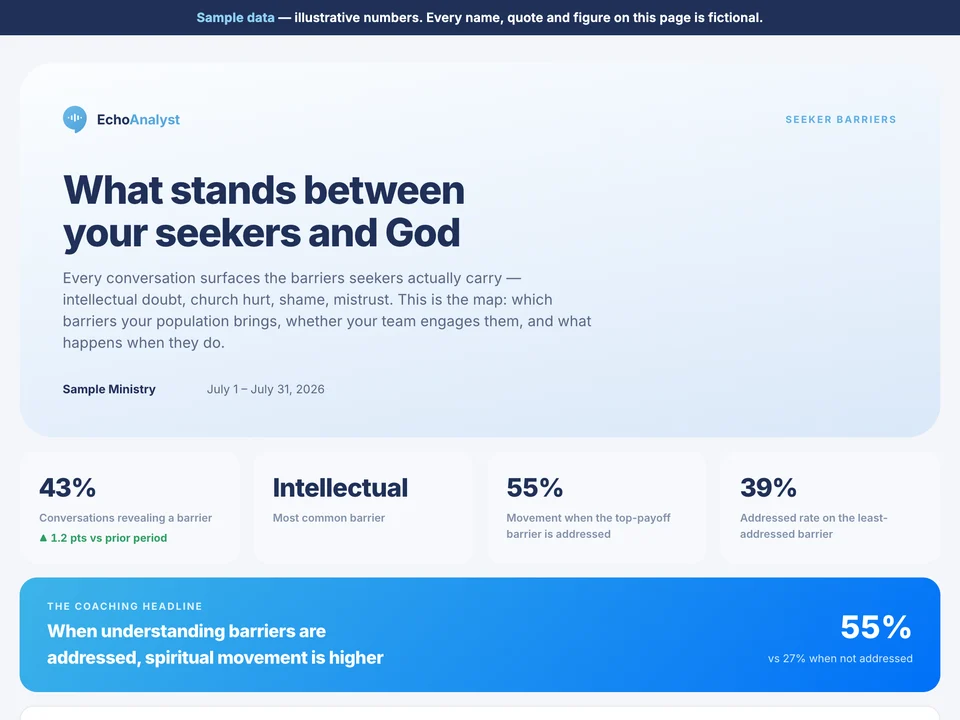 Seeker BarriersWhat stands between our seekers and God, and is it being addressed?
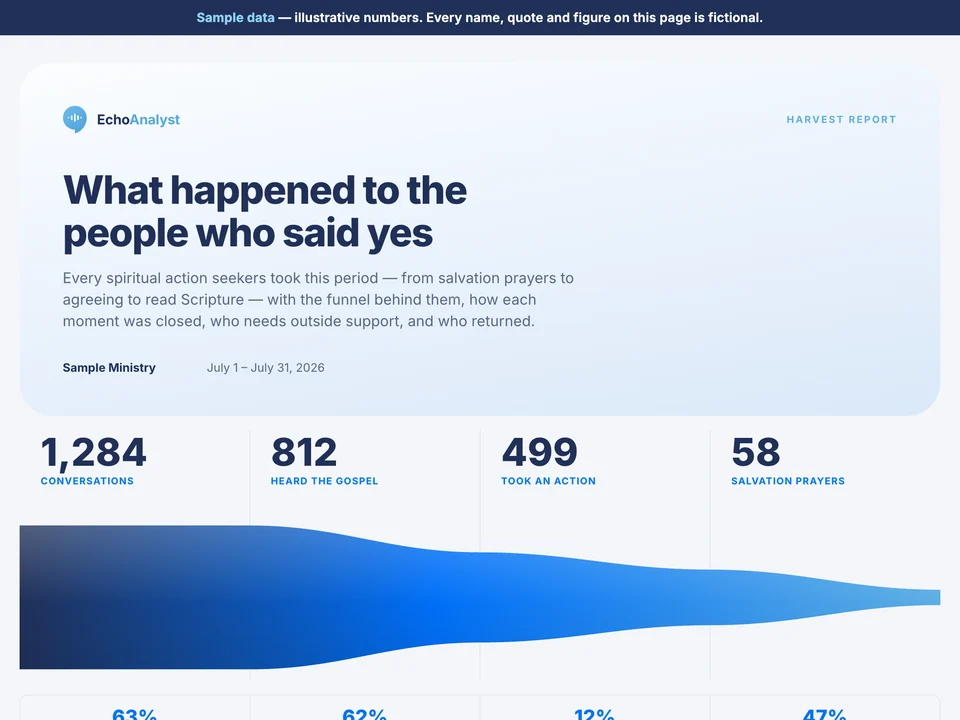 HarvestWhat happened to the people who said yes?
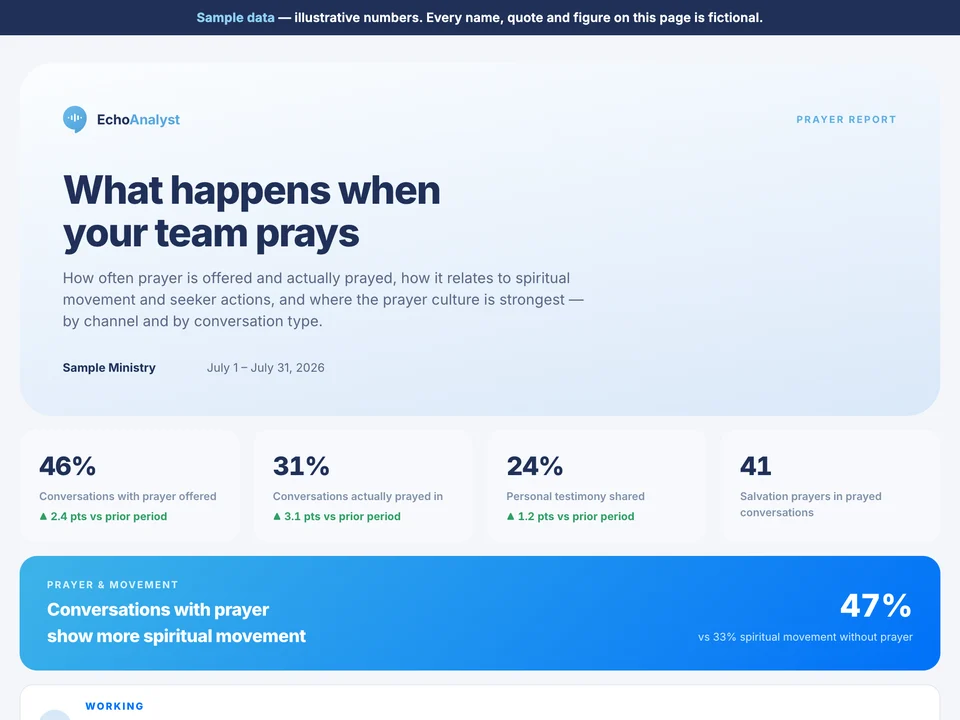 PrayerHow often do we pray with seekers, and what do we see when we do?
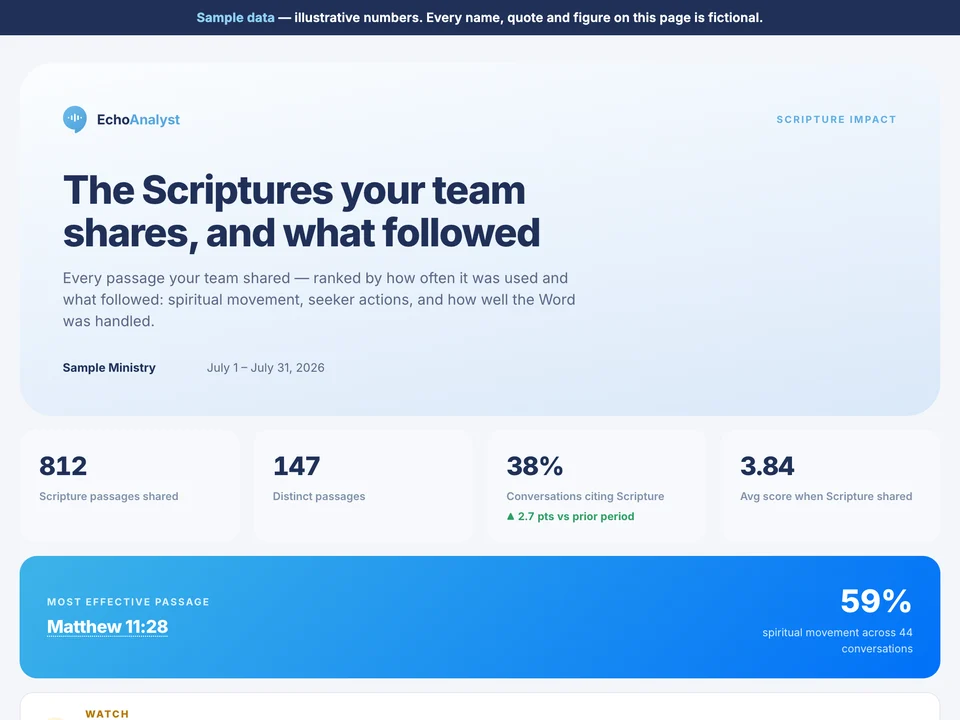 Scripture ImpactWhich Scriptures move seekers, and how well is the Word being handled?
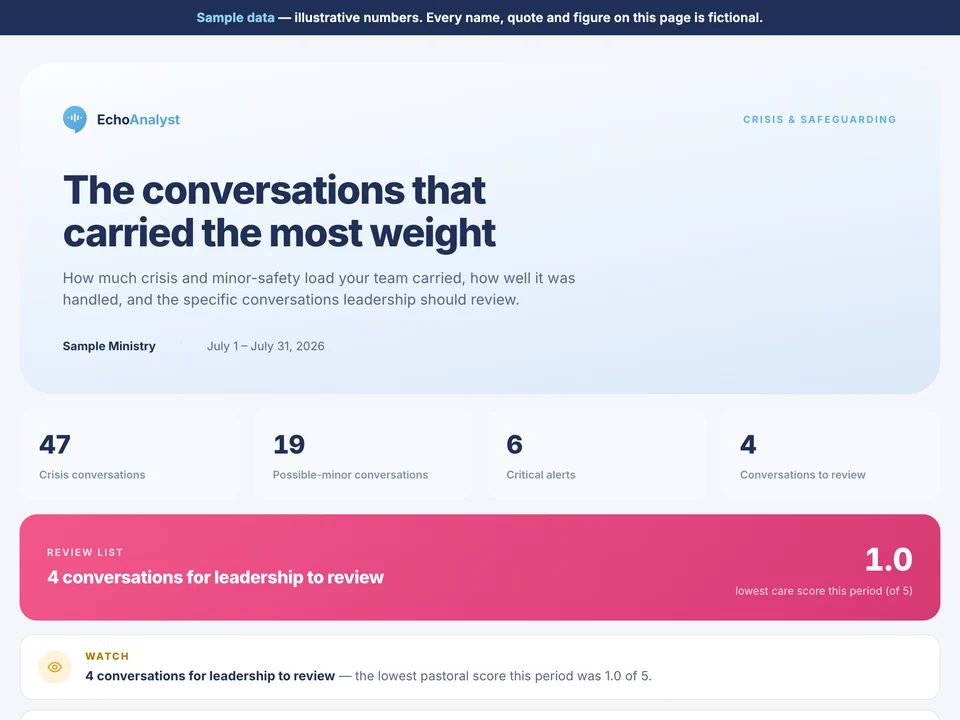 Crisis & SafeguardingHow much crisis weight did we carry, and was it handled well?
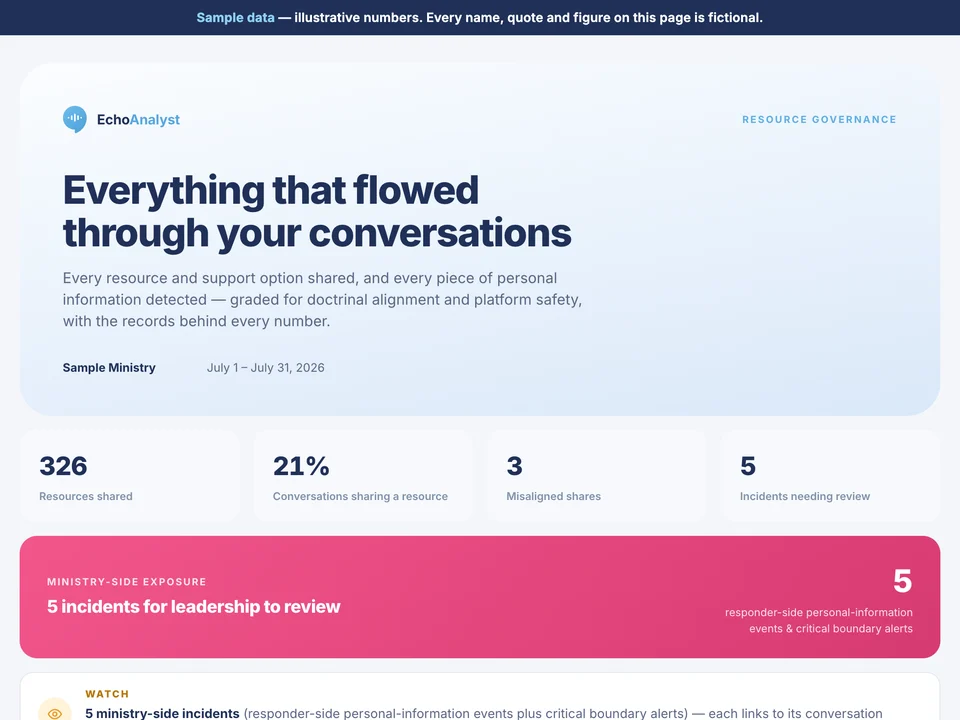 Resource GovernanceWhat left the platform, does it align with our doctrine, and what personal information was shared?
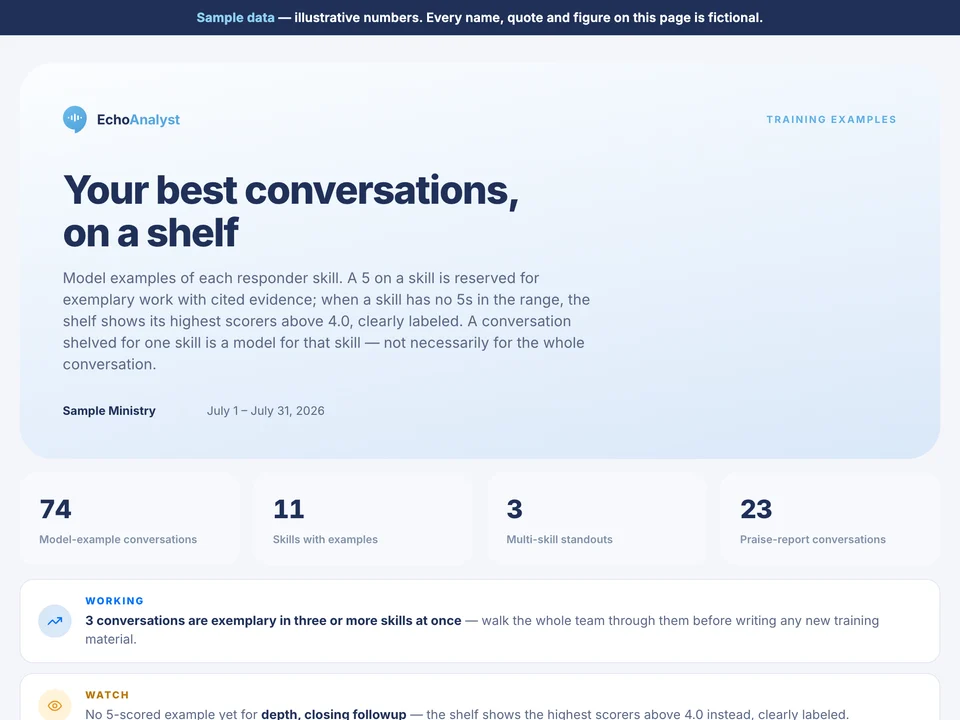 Training ExamplesWhich conversations should we teach from?
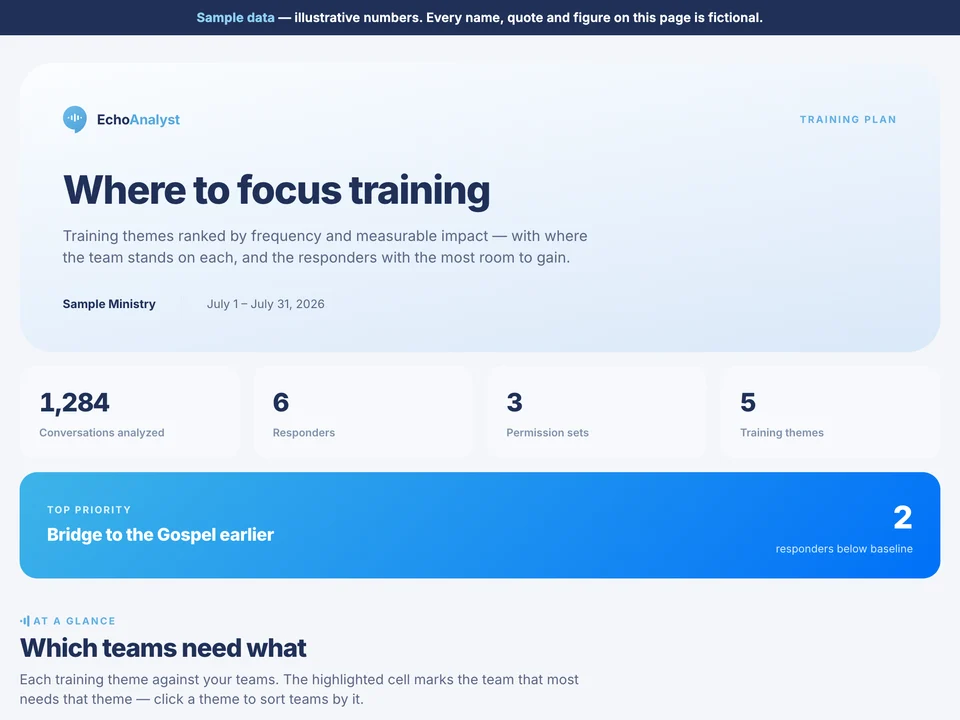 Training PlanWhat should we train on, and who needs it most?
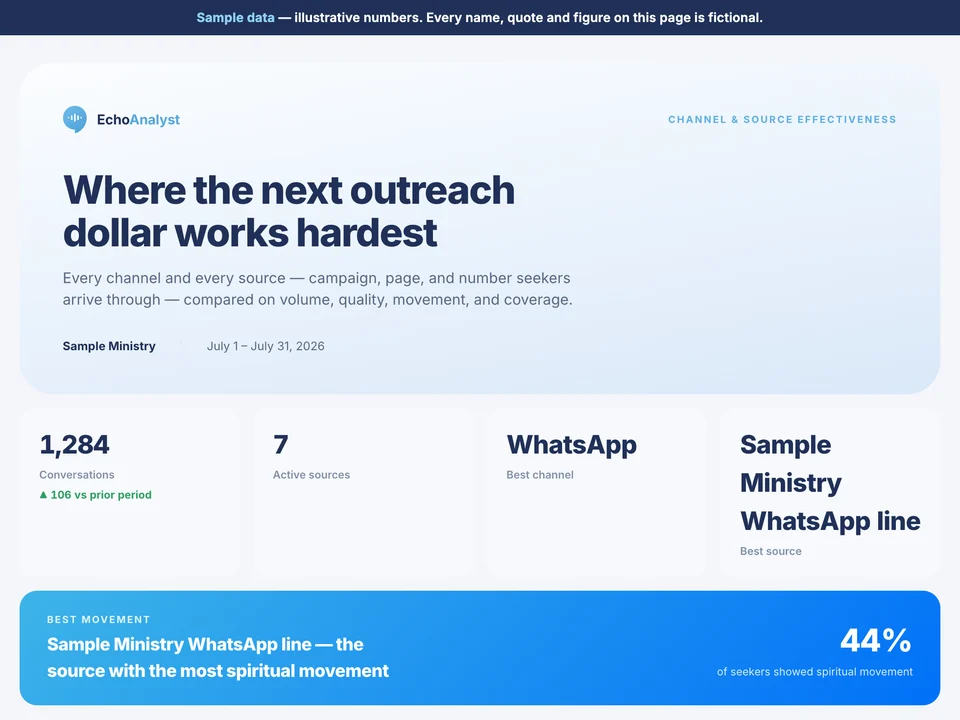 Channel EffectivenessWhich channels and sources bring conversations that actually go somewhere?
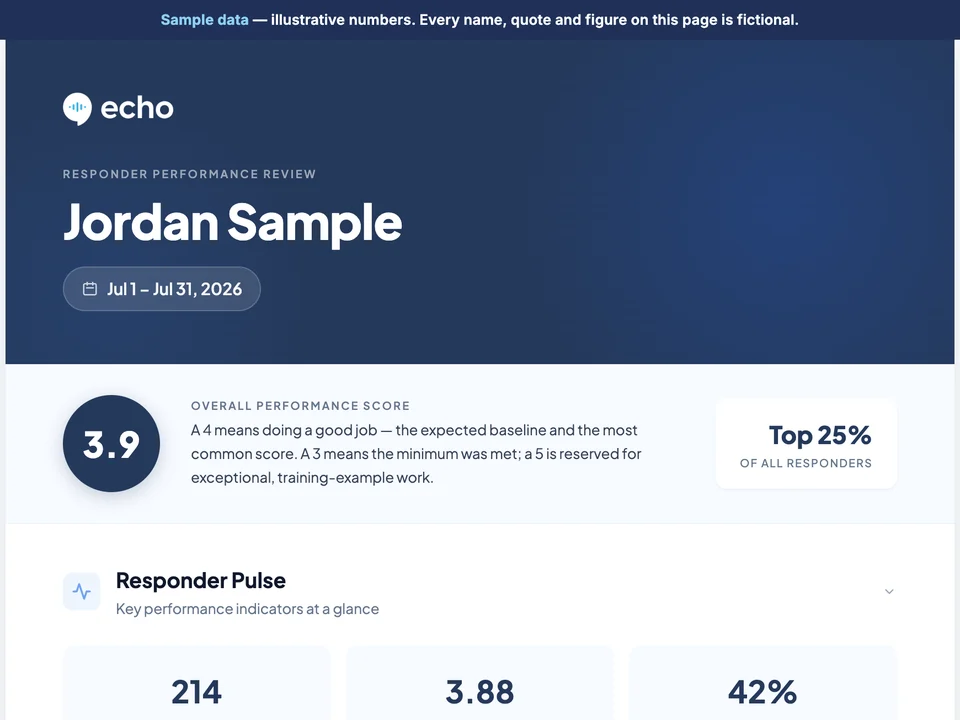 Responder ReviewsHow is this responder doing, and what should they work on next?
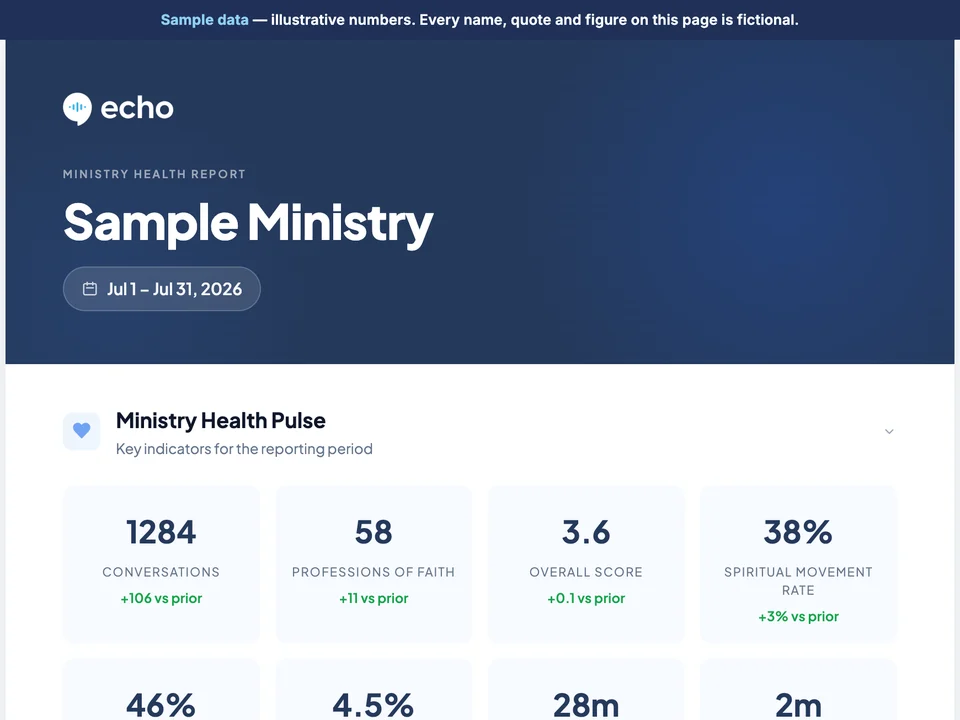 Ministry HealthHow healthy is the whole ministry right now, and versus last period?
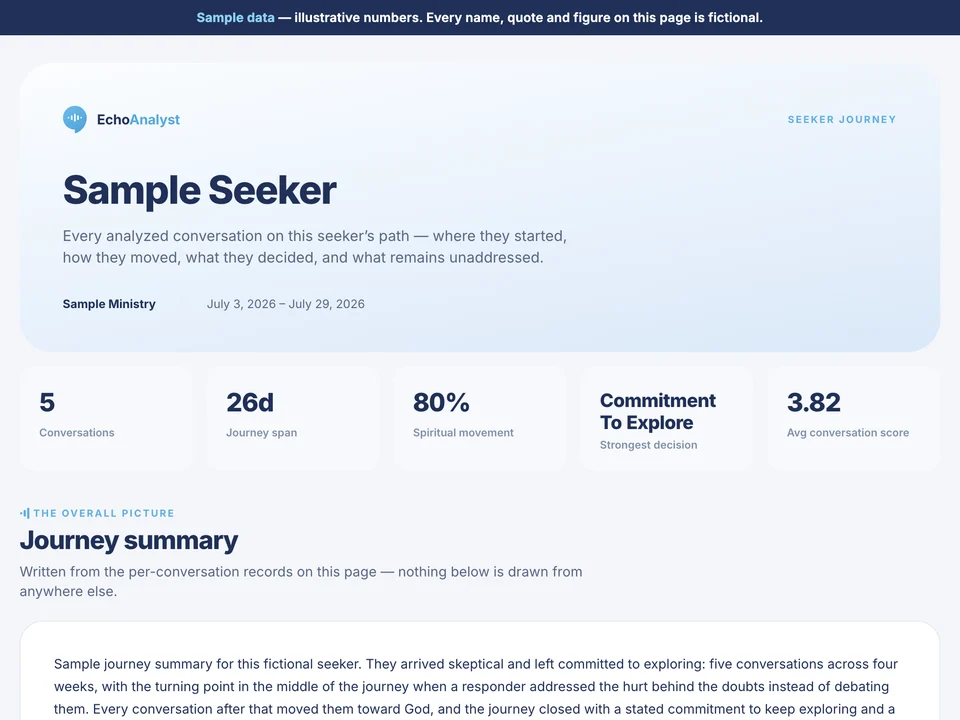 Seeker JourneysWhat has one seeker’s whole path with us looked like?
A Monday morning
One ministry's morning with EchoAnalyst. The people are invented.
A ministry director opens Crisis & Safeguarding. Two Critical items came in on Saturday night, and the text alert reached her then. Both were crisis conversations, both handled well by the responders. A follow-up call is on the calendar. Nothing waited for someone to happen upon it.
A coach generates a Responder Review before a monthly check-in. Instead of skimming five transcripts, she walks in knowing his listening scores rose after last month's training, that Gospel transitions are his next step, and with three example conversations ready.
The communications team opens this week's Ministry Health Report. Among its stories is a seeker who prayed to receive Christ after three weeks of conversations, in her own words, and her Seeker Journey shows every step. It becomes Wednesday's prayer update.
A training lead opens the Training Plan. Missed Gospel transitions top the list, so next week's workshop plans itself, with the example conversations already linked.
None of this replaced a person. It gave everyone in the ministry a clearer view of the work God has them in, and more time to do it.
What comes next
Each next step will be held to the same tests: the evidence for it, whether it can be undone, and whether a person stays in charge.
Each responder's own feedback, their progress over time, and the training that fits them: a coaching plan per person.
Conversations in any language are analyzed today. Next, bilingual coaches will build expert-scored sets, starting with Spanish, so the reading is calibrated for each language and culture rather than assumed.
As coaches confirm and correct evaluations, those become a standing test, and in time could tailor the feedback further, down to the Scripture a responder might share next time.
Anonymized, combined comparisons so partners can learn from each other's strengths, turning one ministry's evaluation into the movement's learning.
Further ahead, an opt-in prompt during a conversation, approached slowly and never distracting from the Spirit's leading or the flow of the conversation.
One prospect moves us most: a shared foundation for evangelism ministries worldwide, where each keeps its own identity and strategy and, behind the scenes, we support one another. "That they may all be one, so that the world may believe." John 17:21

The math
$100 covers up to 10,000 analyzed conversations a month. That is as little as a penny a conversation.
Up to conversations analyzed
$100/mo
$100 per 10,000 analyzed conversations, each month
Billing is by blocks of 10,000 analyses a month, and a partial block counts as a whole block: 3,000 analyzed conversations is one block, 10,001 is two. All fourteen reports are included, and the computed reports run as often as you like at no extra cost. Grow and Multiply include the first block of 10,000 each month. Turn EchoAnalyst on or off from inside your account.
An invitation
EchoAnalyst is live. Turn it on from inside your account, or talk with us first. Ten free analyses a month let you try it before you subscribe.
Champion it as a coach given to your people, not a critic. Pray over it, for the responders who will hear its feedback and for it to serve truthfully. Give one person the time to work with us, gather your responders' reactions, and tell us which measures matter to you.
When the early church appointed deacons to serve, the apostles were freed for prayer and the ministry of the word (Acts 6). Think of EchoAnalyst the same way: it carries the heavy lifting of analysis, so your people can give more of themselves to ministry.