The Hourly report shows your traffic hour by hour: when conversations start, how the ones that ended finished, and how many messages moved in each direction. It is the report to open when you are deciding who needs to be online at which hour.
Running the report
- Open Reports from the main menu. In the left-hand menu, under Reports, click Hourly.
- Click the date range at the top of the page and choose your dates. The globe menu beside it sets the time zone, which starts on your ministry's own.
- Click Sources and choose the conversation sources to include. The number beside it shows how many are chosen.
- Optional: click Permission Sets to count only conversations that someone in those sets claimed. Leave it empty to include everyone.
- Use the switch to choose Created At or Closed At. Leave it on Created At for this report. Every hour here is the hour a conversation started, and the first card does not work reliably with Closed At.
- Click Run Report on each card you want to see. A card does not load until you do, and the button stays gray until you change a filter.
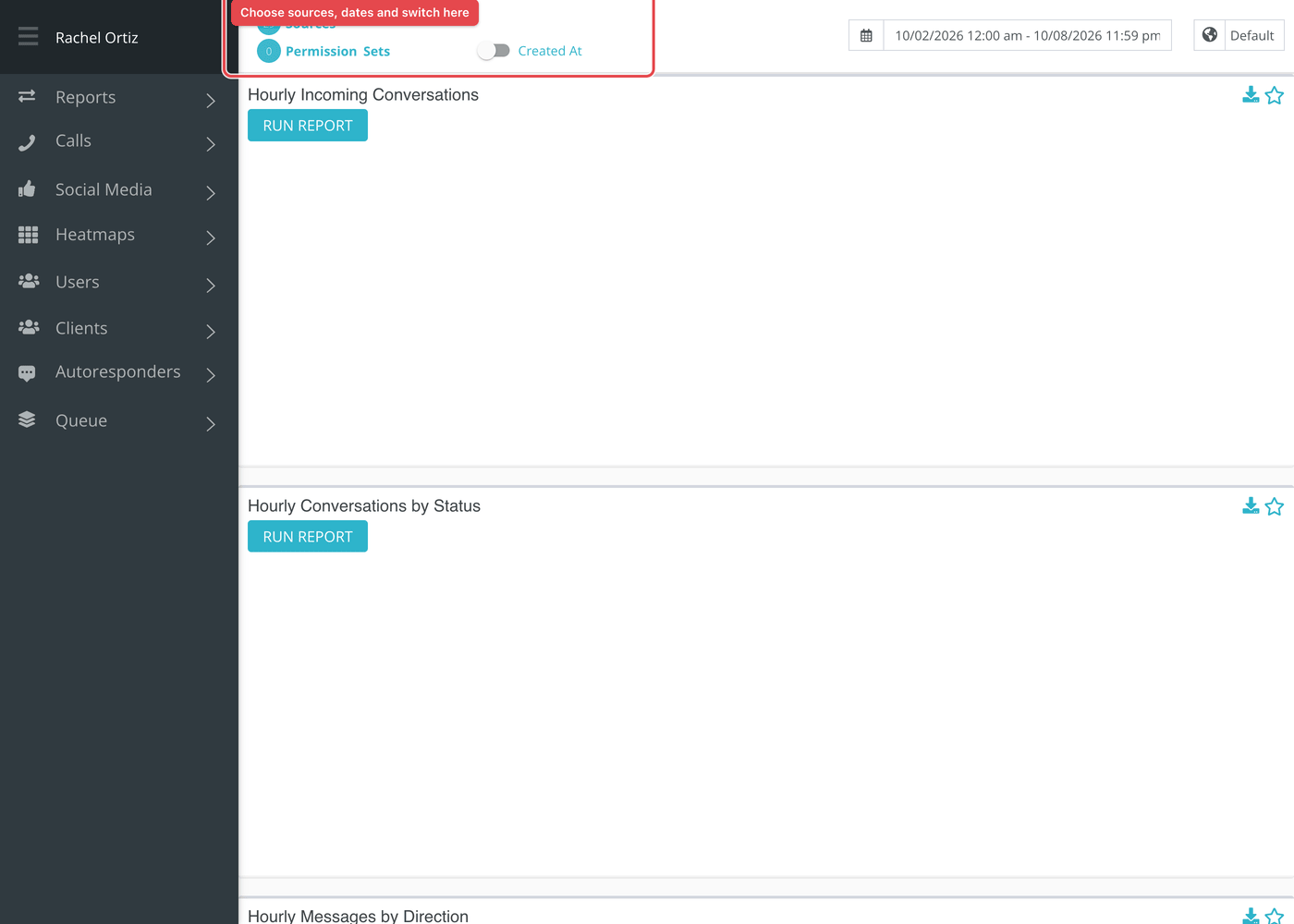
Larger date ranges can take a little while. Reports that are still being built are listed under Queue at the bottom of the left-hand menu, which reads "All Reports Finished Loading" when none are waiting.
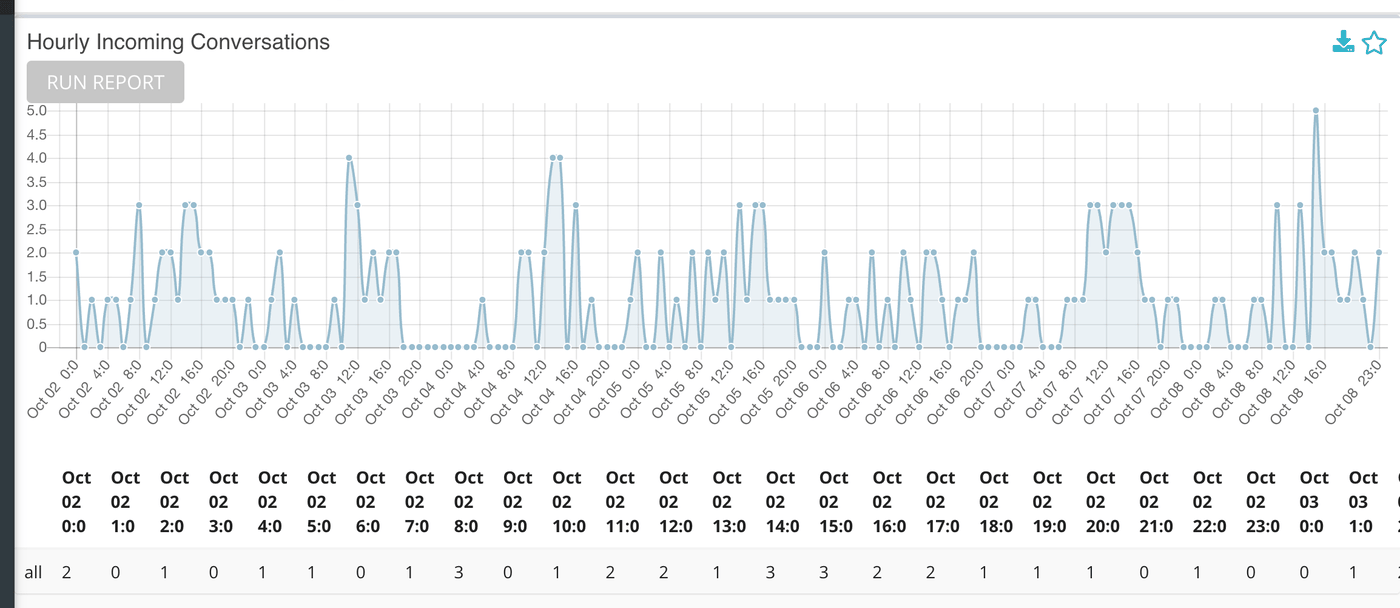
Each card is a line chart with a table under it. The table has one column for every clock hour between your start and end dates, so a seven-day range is 168 columns. Scroll the table sideways to read it.
Hourly Incoming Conversations
One row, all: how many conversations started in each hour.
Hourly Conversations by Status
Three rows, counting the conversations that started in each hour and have since ended: closed, timeout and abandoned. Conversations that are still open are not shown, so this card is for spotting the hours when seekers were lost, not for counting everything.
Hourly Messages by Direction
Two rows, inbound (messages from seekers) and outbound (messages from your team), counted in the hour each message was sent.
This card ignores the sources and permission sets you chose. It always counts messages from every source your ministry has, and it does not use the Created At and Closed At switch.
What the measurements mean
| Term | What it means |
|---|---|
| Hour | One clock hour on one date in the time zone you picked. It is not an hour-of-day average across the days. |
| Closed | Ended with an outcome. |
| Timeout | Ran out of time before anyone responded. |
| Abandoned | The seeker left before a responder picked up. |
| Inbound / outbound | Inbound is sent by the seeker. Outbound is any message that the seeker did not send. |
Things to know
- Because every date has its own columns, one very busy day shows as a tall spike rather than being averaged away. To compare the same hour across a month, read the same column positions week to week, or look at the reports in the Heatmaps group of the left-hand menu.
- The time zone you pick moves the hour boundaries. Check it before comparing two reports.
Most cards also carry two small icons beside the title. The star pins the card to your Dashboard. The download icon saves the card as a CSV file, or as XLSX if your download preference is set to XLSX.