“Sub Convs” is short for subscriber conversations. When someone texts a keyword to join a campaign, they may also start talking with your team. This report counts those conversations and shows how they turned out, so you can see whether a campaign leads to real ministry and not only to sign-ups.
Its mirror image is Non-Sub Convs, which counts conversations from everyone else.
You need to be an admin, or to have been given access to the Reporting module, to open Reports. These pages are in the classic Reports area. The newer Analytics area is a separate set of reports.
Where to find it
- Click Reports in Echo’s main menu.
- In the left menu, open the Autoresponders group and click Sub Convs.
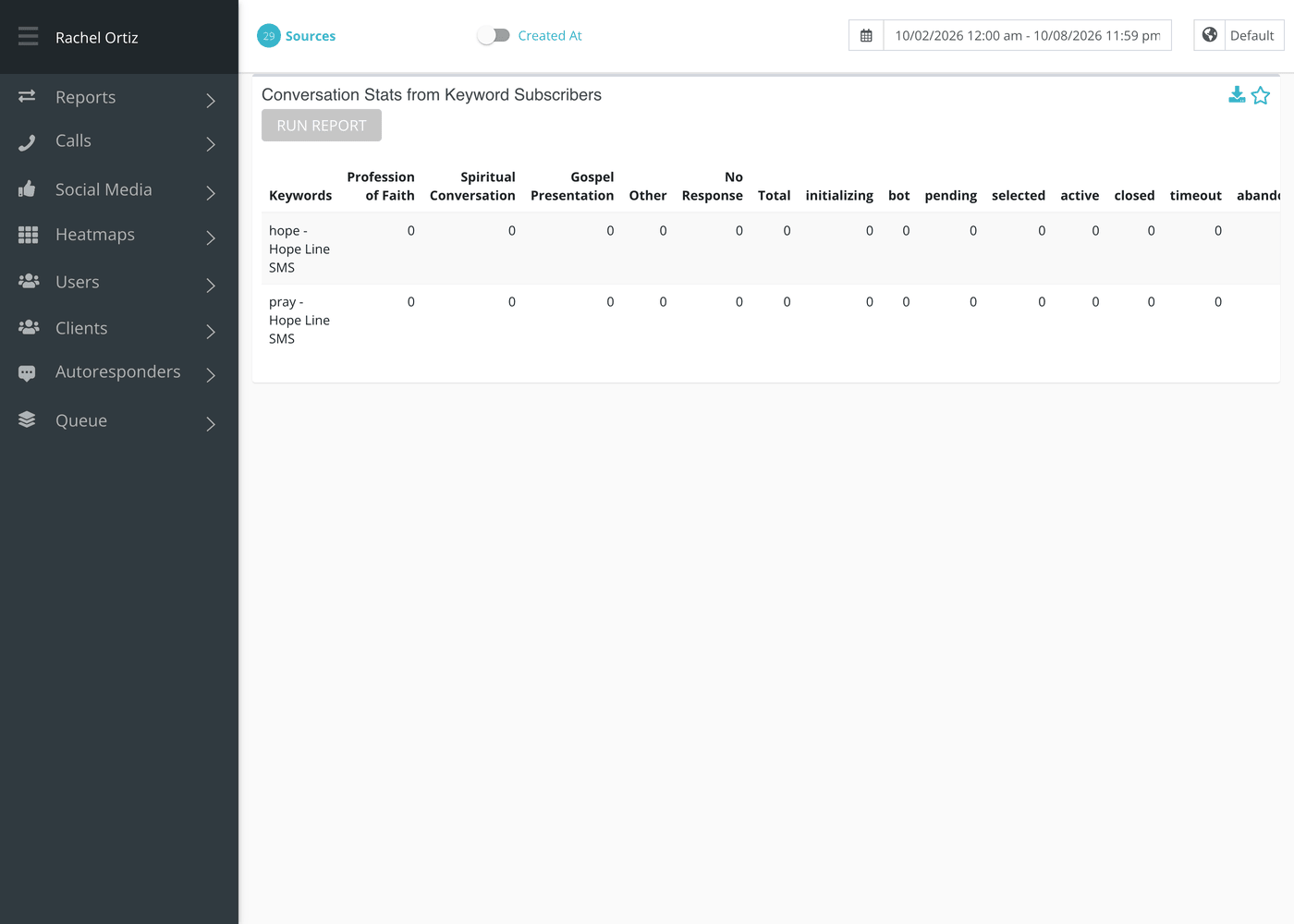
- Pick a date range and, if you need to, a time zone at the top of the page. Open Sources to choose which of your sources to include.
- Use the Created At / Closed At switch in the top bar to choose which date the conversations are placed by.
- Click Run Report on the card. The report runs in the background, so give it a moment on a long date range.
Reading the table
There is one row for each campaign, labeled with its keyword and source, for example HOPE - Main Line. The columns run in two groups.
| Columns | What they count |
|---|---|
| Outcome columns (one for each of your active outcomes) | Conversations that were given that outcome. |
| First Total | All conversations that have an outcome. Conversations without one are not in this number. |
| Status columns (one for each conversation status) | Conversations in that status: initializing, bot, pending, selected, active, closed, timeout, abandoned, hidden or blocked. |
| Second Total | All conversations in the range for the campaign’s subscribers, with or without an outcome. |
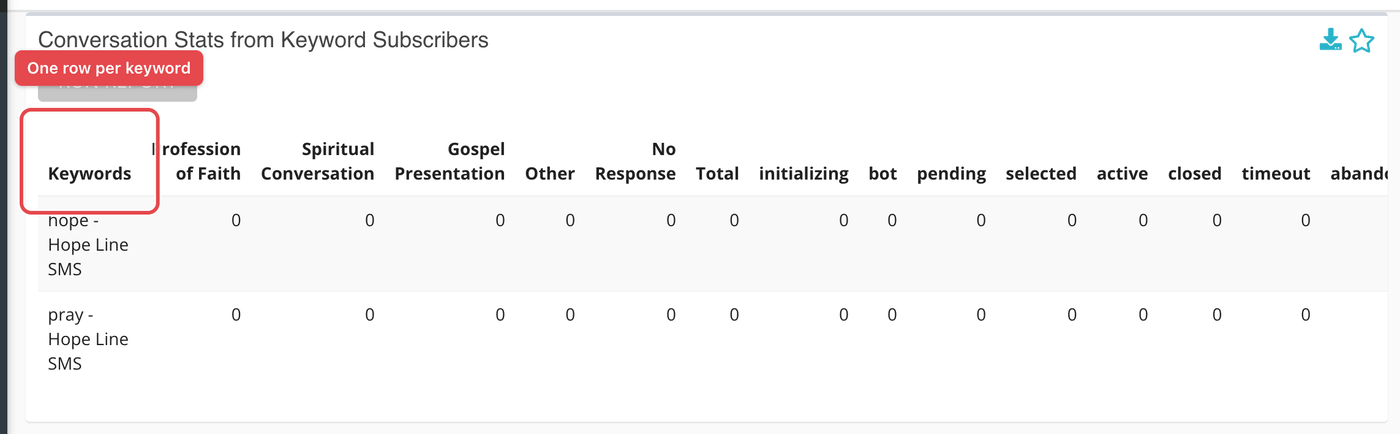
Because the first Total leaves out conversations that have no outcome, it is often smaller than the second.
Which conversations are counted
- Only people who subscribed during your date range are looked at. Someone who joined before the range is not counted here.
- Only conversations on the same source as the campaign are counted.
- The conversation must fall in your date range, by its created date or its closed date depending on the switch.
A campaign is included when it started on or before the end of your date range, has not ended before the end of the range, and was not archived before the end of the range. That is why a campaign you archived last week still shows in a report for the month before.
What the measurements mean
| Term | What it means |
|---|---|
| Subscriber | A person with a subscription to the campaign’s keyword that was created in your date range. |
| Outcome | The result a responder records when a conversation ends, such as the ones listed in your Outcomes settings. See Status and Outcome Reports. |
| Status | Where a conversation is in its life, from pending through closed. |
| Created At / Closed At | Whether a conversation is placed in the range by when it started or when it ended. |
If something looks wrong
- Every number is zero. Subscribers may not have started conversations, or the campaign’s source is not among your selected Sources.
- A subscriber’s conversation is missing. It may be on a different source than the campaign, or the person joined before your range.