Before you start
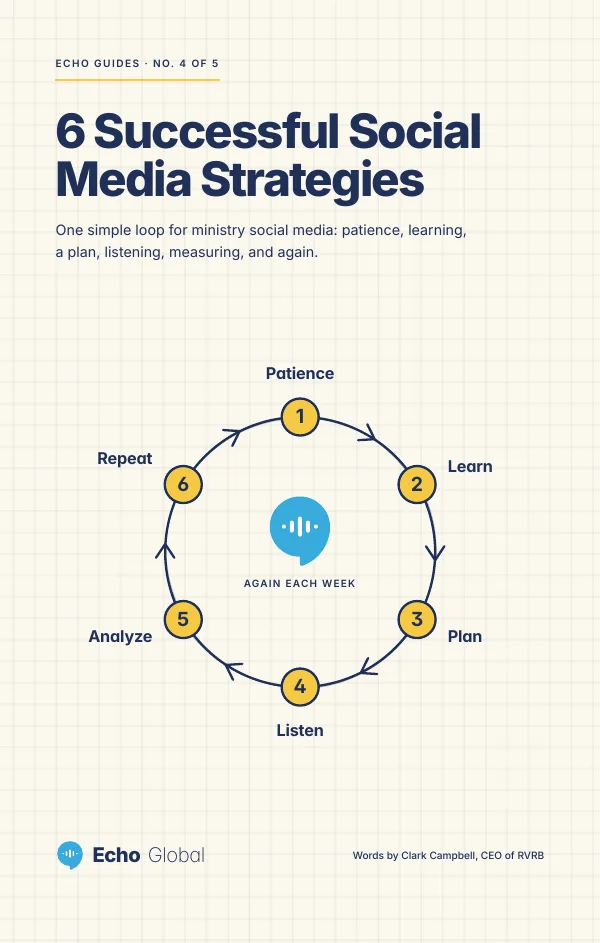
Six strategies. One loop.
Most advice about ministry social media is a list of tricks. This guide is a loop. You walk it once this week, and next week you walk it again.
- 1 Patience Give it time. One post proves nothing.
- 2 Learn Keep up, or bring in someone who will.
- 3 Plan Keep it small enough to finish.
- 4 Listen Read what people write, then answer.
- 5 Analyze Read what happened, not only what was counted.
- 6 Repeat Go round again, a little wiser.
Each step has an opener, a page of teaching with one thing to do this week, and a page that goes deeper with what Echo has learned and the evidence behind it. Worksheets are in the back. Sources are listed at the end.
Step 1 of 6
Patience
One post proves nothing.

Give it long enough to learn something.
The idea
Many ministries quit social media because it "didn't work." They tried two or three posts, maybe a small ad, and judged everything by that. There are too many channels, audiences and goals for that to tell you anything. One ministry wants people at an event. Another wants giving. Another wants seekers to write in. Each has to find what works for it.
In practice
There is no cookie-cutter method, and a trick that worked yesterday can stop tomorrow. It is a long game. Things you have done for six months may start to fail in the next six, and the patience to rethink them will serve you well. Platforms also change how far a post travels, and they do it without asking you, so a quiet week is not a verdict. Give yourself and your team grace.
This week
- Write one sentence about what you want in the next 90 days.
- Pick one kind of post and test it for four weeks before judging it.
- Tell your team that a slow start is allowed.
In Echo
Echo does not ask you to get posting right first. Every message and comment from your connected channels lands in one shared inbox, so a person can answer a seeker even while your plan is still a draft.
A rubric is not finished the day it ships.
What Echo has learned
Echo's own conversation rubric was corrected three times in its first months, in public. First it was too harsh: early scores put whole teams in a narrow band well below where experienced coaches placed them, so the anchors were rewritten so that doing the work well scores a 4. Then it punished silence: a responder who sent a complete Gospel presentation to a seeker who then went quiet was marked down for not asking follow-up questions, so the rubric learned to recognize a missed chat and reward that faithfulness. Then the alert tiers were re-cut, because Critical had been crying wolf. Each correction ships as its own numbered version that can be rolled back on its own. The lesson for your page: expect your first plan to be wrong in ways you can only see by running it.
Evidence
Candid's communications team tested more posting over two months. They raised their Twitter (now X) posts from about 10 to about 20 each weekday. Total engagement rose with volume, but average engagement per post did not, and they judged 20 a day not sustainable and moved back to about 10. In their words, "The key to any social media account is really consistency." More is not the same as better, and steady beats frantic.
Kate Meyers Emery, Candid, "Experiment: Does posting more on Twitter pay off?". https://candid.org/blogs/experiment-does-posting-more-on-twitter-pay-off/
Step 2 of 6
Learn
Keep up, or bring in someone hungry to.

Are you willing to leave the comfortable corner?
The idea
Keeping up with social media takes a real commitment to learning. Clark asks the leader a plain question: am I committed enough to learning that I will leave my comfortable corner and stay with it? It may not even need to be you. It may mean bringing in someone who is hungry to learn how to communicate better on these platforms.
In practice
Learn where people are willing to talk to you. Short videos on TikTok, Instagram and YouTube carry much of what feeds once did, X is the new name for Twitter, and a great deal of real conversation happens privately in WhatsApp, Messenger, Instagram messages, Telegram and LINE. Learn the new tools, including AI ones, without handing over the conversation. The three tests we use at Echo: is there evidence, can it be undone, and is a person in charge.
This week
- Choose the one platform your seekers use most.
- Ask the teammate who uses it most to show you how they use it.
- Name one person who owns learning for the team, and give them an hour a week.
In Echo
A person answers every seeker. Echo's AI only reads afterward, and never writes a seeker's reply. Echo Academy has short courses for responders on getting started, first conversations and reading your reports.
Learn from the conversations, not only the feed.
What Echo has learned
Echo reads each closed conversation against a rubric of eleven skills: eight asked of every conversation and three only when the situation arises. They include listening, engagement, clarity, depth, use of Scripture and flow. Each is scored 1 to 5, and four means doing the work well. Scores come with a one-sentence coaching note, so the learning is specific: not "be better," but "this is the moment the seeker named a barrier and the answer went past it." That is also how you can learn on your own: pick five real conversations and read them as a coach would.
Evidence
Where do people spend their time? Share of U.S. adults who say they ever use each platform.
- 84% YouTube
- 71% Facebook
- 50% Instagram
- 37% TikTok
- 32% WhatsApp
Jeffrey Gottfried and Eugenie Park, Pew Research Center, "Americans' Social Media Use" (survey of 5,022 U.S. adults). pewresearch.org
Step 3 of 6
Plan
Success is planned. Start small.
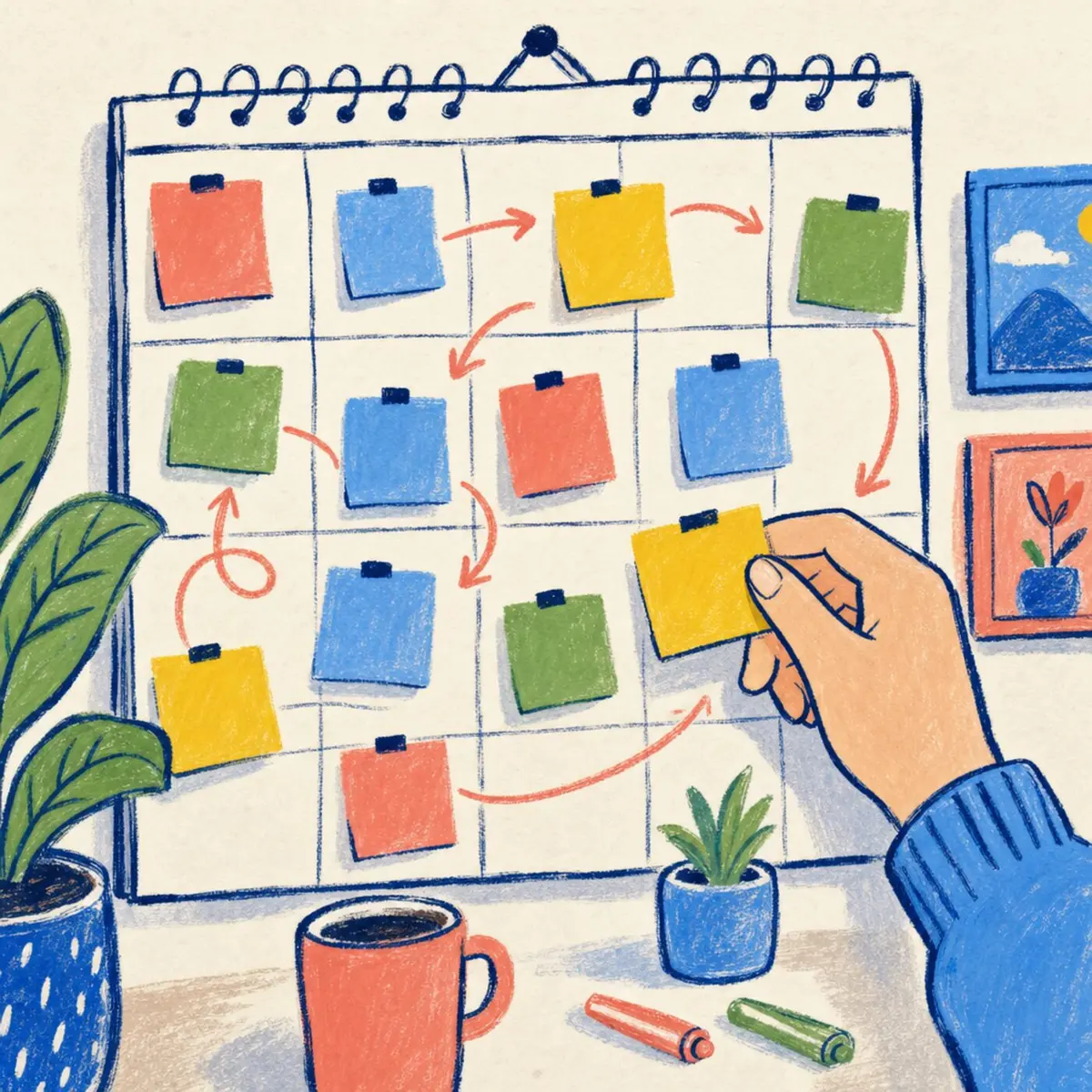
A plan simple enough to finish.
The idea
Combine your patience with your learning and make a plan. It does not have to be complex unless you have a big team of content creators and community managers. Start small: post only three times this week, or spend 30 minutes a day reading and talking with people online. If a small plan works, build on it.
In practice
Too many ministries are stretched thin, with more plan than time, people or money, and they sit near burnout instead of fruit. Nobody gives their life to ministry to end up deflated. Clark's reminder: Jesus had a plan for his ministry, so we can have one too. Plan for what happens after the post, not only the post: when someone comments with a real question or sends a private message, who answers, on which app, and how soon? Choose one or two channels to do well.
This week
- Fill in the one-page plan.
- Put your three posts for the week on the calendar.
- Put 30 minutes a day on the calendar for reading and answering.
In Echo
Echo answers the "who answers" question: messages and comments from the apps you connect arrive in one inbox, where a responder claims a conversation, so two people do not answer the same seeker and none is missed.
Plan for the answer, not only the post.
What Echo has learned
When ministries plan, they usually plan content. The conversations that matter happen after it. In Echo, every conversation can be claimed by one responder, so your plan can name who is on this week, which channels they cover and what a good reply looks like. A good reply, by Echo's rubric, is not the longest one: it reflects the seeker's situation back accurately, asks open questions and keeps replies short enough to read. Put that on your plan page next to your three posts.
Evidence
Candid's test also taught them what to aim at: frequency should balance what the audience needs with what the organization can sustain. They settled on about 10 a day on weekdays.
Kate Meyers Emery, Candid. https://candid.org/blogs/experiment-does-posting-more-on-twitter-pay-off/
Plan · worksheet
Our one-page plan
Write on it. Keep it where the team can see it.
- Who we want to reach
- Where they are (one or two apps)
- Our three posts this week
- Who answers, and how soon
- When we look at what happened
Step 4 of 6
Listen
Talk less. Notice more.
Listening online starts where people write.
The idea
Talk less and listen more. Clark pointed to a simple move: instead of using your page only for announcements, ask a question people want to answer, such as how you can pray for them this week, and then read what comes back and reply. You have to be much more intentional about how you listen. Engage. Be present instead of a flat, cold feed.
In practice
Today the most honest messages usually arrive privately, and often late at night. A seeker who would never write on your public post will write to you in a message. A comment that asks a real question deserves a real conversation, not a like. Read first. Then answer, and answer soon.
This week
- Spend 30 minutes a day reading what people write to you. Do not post.
- Write down three questions seekers asked, in their own words. Use the listening log.
- Reply to every question for a week, even briefly.
In Echo
Echo brings private messages and comments from your connected apps into one inbox, and a comment that asks a real question can become a conversation that a responder claims and answers.
The barrier is in their own words.
What Echo has learned
When Echo reads ministry conversations, it records two lenses: each seeker's starting posture (six kinds, plus unclear) and the barriers they carry (seven kinds). A barrier is something that stands between the seeker and God, such as grief, loneliness or church hurt. Echo also records whether the responder engaged the barrier. "Engaged" means the responder addressed it in the conversation, not that it was resolved. The Seeker Barriers report then shows, with a ministry's own numbers, how often seekers move toward God when their real barrier is addressed rather than passed over. Listening is also one of the eleven skills: did the seeker feel known?
Evidence
Private messaging apps give you a window to answer in. Meta's documentation for WhatsApp says that when a user messages your business, a 24-hour customer service window opens, and inside it you can send non-template messages. Other apps set their own windows. The practical point is the same everywhere: a seeker's message has a short window for a warm reply.
Meta, "WhatsApp Cloud API Get Started," developer documentation. https://developers.facebook.com/documentation/business-messaging/whatsapp/get-started
Listen · where seekers write
Two kinds of places to listen.








Listen · worksheet
Listening log
One line each. Use their words, not yours.
| Where | What they wrote, in their words | Barrier or need | Answered? |
|---|
Step 5 of 6
Analyze
Count less. Read more.
Look at what happened, then ask why.
The idea
Once you have listened, analyze. What did people post? When? How? Say one Monday post draws far more comments than last Monday's. Why? The time of day? An image? A video? Every platform offers free analytics, so use them. Learn to go in and see the details. Whatever you measure can be improved.
In practice
The free tools change names and layouts, and the best times to post change too, so test them instead of assuming them. And remember that likes and views tell you what was seen. They do not tell you whether anyone was helped. Add one question that counts cannot answer: did this person feel known, and did anything move?
This week
- Open each platform’s free analytics once this week.
- Compare two posts. Write one guess about why one did better.
- Read five real conversations and ask: did this person feel known?
In Echo
EchoAnalyst, Echo's paid add-on, reads each closed conversation about a minute after it ends, scoring responders on eleven skills and tracking seeker movement.
Measure movement, not only counts.
What Echo has learned
Leaders often end up with a spreadsheet of counts built the night before, and counts train a team to value what can be counted. Echo's analysis reads the seeker's own words and records movement and the steps seekers take: six kinds of step are recorded, from a salvation prayer or a rededication to a commitment to keep exploring, agreeing to read Scripture, agreeing to attend church, or asking for follow-up. One step is recorded per conversation. Scoring is built so a serious failure cannot hide inside a good average: one question scored 1 caps the conversation at 3.0. And no measure can see what the Spirit is doing beneath the surface. Movement is a tool for stewardship, not a scoreboard for souls.
Evidence
Different platforms serve different habits, so look at your own numbers first. Share of U.S. adults who say they regularly get news on each platform.
- 38% Facebook
- 35% YouTube
- 20% Instagram
- 20% TikTok
- 12% X
Pew Research Center, "Social Media and News Fact Sheet." https://www.pewresearch.org/journalism/fact-sheet/social-media-and-news-fact-sheet/
Step 6 of 6
Repeat
Go round again, a little wiser.

Keep it simple. Make it a habit.
The idea
Whether it is every day or every week, go back and do it again. Be patient. Be committed to learning. Make a plan for this week. Listen to the people you serve, show that you are listening, analyze, and repeat. Clark's summary of his plan is these six things. You do not have to like or comment on everything you read.
In practice
The loop is the strategy. Pick a day. Plan on Monday, listen all week, analyze on Friday, and write one thing to change. Once a month, step back further with the monthly review. The point is not a perfect result. It is a team that keeps getting a little better at hearing people.
This week
- Choose your weekly day. Put it on the calendar.
- Use the weekly sheet on the next pages.
- Share one thing you learned with your team on Friday.
In Echo
EchoAnalyst's Responder Review shows each responder's scores by week, beside the team average and the last period, so a weekly return to the loop has something real to look at.
How Echo keeps its own loop.
What Echo has learned
Echo runs the same loop on its own rubric. Score distributions are watched every reporting period. Coaches review real evaluations against real conversations. Each correction ships as a numbered version that can be rolled back on its own. And any output is under human authority: if a mentor or leader disagrees with an evaluation, the person's judgment wins. It is a tool for encouragement, not an automated boss. Copy that for your team: look at the numbers on a schedule, check them against real conversations, change one thing at a time, and let the people closest to the ministry overrule the chart.
Repeat · worksheet
This week's loop
Copy this page each week.
- 1 Patience · What is one thing I will not judge yet?
- 2 Learn · What do I need to understand better?
- 3 Plan · What am I testing this week?
- 4 Listen · What did seekers actually write?
- 5 Analyze · What happened, and why do I think so?
- 6 Repeat · One thing I will change next week
Repeat · worksheet
Monthly review
Once a month, with your team, for an hour.
- What did we try this month, and what did we keep?
- Which conversations taught us the most? (Read five.)
- What barriers did seekers name most?
- What moved, as far as we could see? What did we not see?
- What will we stop doing?
- What is our one goal for next month?
Sources
Where the evidence comes from.
- Gottfried, Jeffrey, and Eugenie Park. Pew Research Center. "Americans’ Social Media Use."
pewresearch.org - Pew Research Center. "Social Media and News Fact Sheet."
https://www.pewresearch.org/journalism/fact-sheet/social-media-and-news-fact-sheet/ - Meyers Emery, Kate. Candid. "Experiment: Does posting more on Twitter pay off?"
https://candid.org/blogs/experiment-does-posting-more-on-twitter-pay-off/ - Meta. "WhatsApp Cloud API Get Started." Developer documentation.
https://developers.facebook.com/documentation/business-messaging/whatsapp/get-started - EchoGlobal. EchoAnalyst product page: the eleven-skill rubric, scoring cap, seeker barriers and postures, steps recorded, calibration.
https://www.echoglobal.org/product/echoanalyst - EchoGlobal. Integrations and channels page: messages and comments from connected apps, TikTok and YouTube as comments only.
https://www.echoglobal.org/product/integrations
Credits
Whose words these are.
The ideas in this guide are Clark Campbell's. He is the CEO of RVRB, and he shared them in a conversation with Andre at Echo.
The Echo notes, evidence pages and worksheets were added by Echo.
Public comments
The comments under your posts and live videos on Facebook, under your Instagram posts, and under videos on TikTok and YouTube. Public, so a good answer teaches everyone watching.
TikTok and YouTube are comments, not private messaging. Echo lets your responders read and answer them from inside Echo, but it cannot start a private message there.