Training Examples answers a question every trainer has: not what good looks like in the abstract, but which of our conversations to put in front of a new responder.
The question the report itself names is: Which conversations should we teach from?
Running it
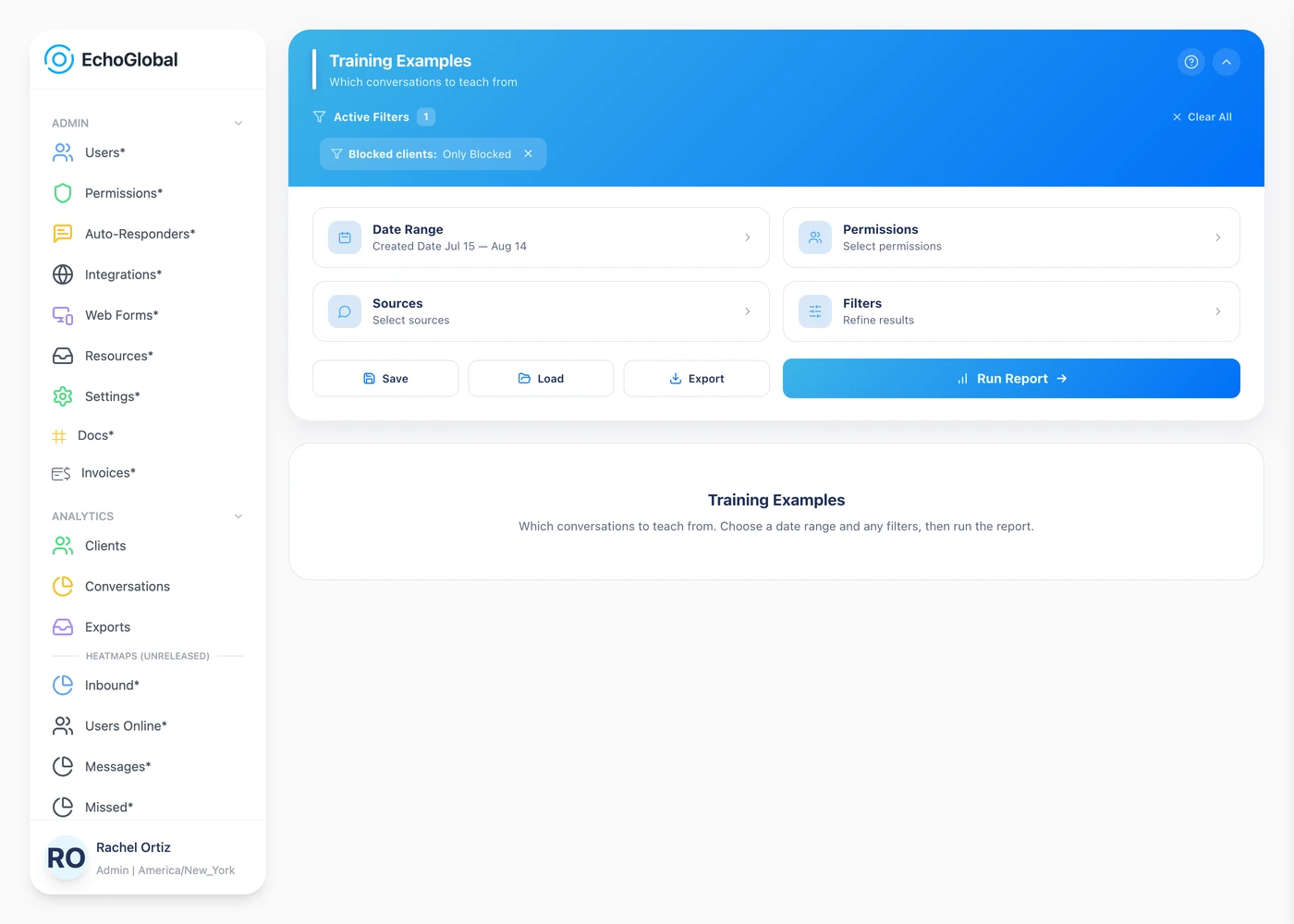
Open EchoAnalyst in the left-hand menu, then Training Examples. Set a date range, choose your sources if you want to narrow it, and select Run Report. Nothing is computed until you do.
The controls are the same on every Echo Analyst report. They are described once in Getting started with Echo Analyst.
What the page shows
Multi-skill standouts are the conversations that demonstrate several skills at once, the best single things to teach from.
The library is the rest, shelved by the skill each conversation demonstrates, so you can pick an example for the specific thing you are training.
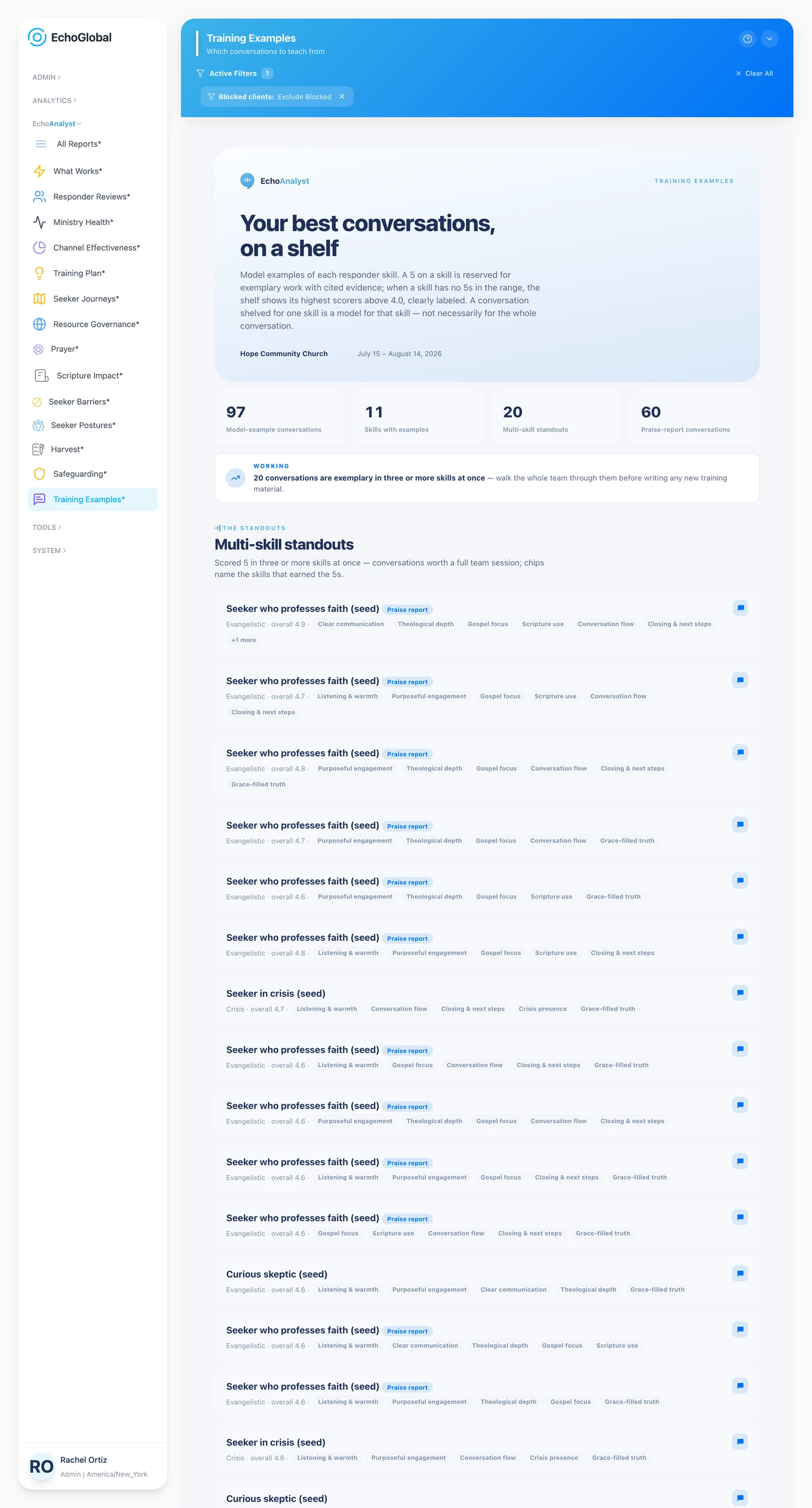
The report itself opens with a Definitions section carrying the same terms in short form, so you can check a word without leaving the page.
What the measurements mean
Conversations are shelved by the skill they demonstrate. There are eleven skills, each scored 1–5 on every conversation where it applies.
Listening · engagement · clarity · depth · Gospel focus · Scripture use · conversation flow · closing and follow-up · crisis sensitivity · grace-filled truth · minors handling.
The 1–5 scale
Every skill score in Echo Analyst uses the same five points, and the wording matters. This is not a school grade where 5 is the target.
| Score | What it means | How often |
|---|---|---|
| 1 | Harmful, real harm or a protocol violation, such as missing a crisis or a doctrinal error | Rare |
| 2 | Below standard, a coachable weakness | Uncommon |
| 3 | Met the minimum, acceptable, with clear room to grow | Less common |
| 4 | Doing a good job, the expected baseline for someone doing the work well | Most common |
| 5 | Exceptional, training-example quality, and it requires specific cited evidence | Rare |
4 is the target, not 5. A team averaging 4 is doing the job well. A 5 has to be earned with evidence, so a page full of 5s would be a scoring fault rather than a triumph.
Two rules change how the number comes out. A 1 in any single skill caps the whole conversation's overall score, real harm is not averaged away by nine good things. And three skills return nothing at all when they do not apply: crisis sensitivity when there was no crisis, grace-filled truth when no hard truth was needed, and minors handling when no minor was involved. A blank is "not applicable", never zero.
How a conversation reaches a shelf
- A score of 5 qualifies outright, and 5 requires specific cited evidence, which is why the shelves are short.
- When a skill has no 5s in your date range, its highest scorers above 4.0 are shelved instead, and the page says so. A shelf is never silently diluted.
- Only conversations carrying a type, an overall score and a coaching note can reach a shelf at all. That filter exists because a thin analysis with a flat set of top scores would otherwise land on every shelf at once.
Multi-skill standouts are conversations qualifying on several skills at the same time. Each shelf holds up to 20.
Reading it honestly
A conversation qualifies outright with a score of 5, which the scoring rubric reserves for exemplary work with cited evidence. When a skill has no 5s in your date range, the shelf falls back to its highest scorers above 4.0, and says so on the page. A shelf is never silently diluted; if it is showing fallbacks, it tells you.
Only conversations carrying a type, an overall score and a coaching note can reach a shelf at all. That filter exists because a thin analysis with a flat set of top scores would otherwise land on every shelf at once.
Each shelf holds up to 20 examples.
If it comes back empty
Two things cause this, and neither means the report is broken.
The Sources filter remembers what you last chose. A selection made months ago can exclude everything you have added since. Open Sources, check what is ticked, and run it again.
Only closed conversations are analyzed. A conversation that is still open, or that was abandoned before your team replied, carries no analysis and appears in no number here. A busy period can still be a thin one for this report if most of it never closed.