Seeker Journeys is the report for one person rather than one period: what has one seeker's whole path with us looked like?
It is the one to open before a follow-up call, when someone has come back for the third time and you want to know what has already been said to them.
How a narrative review is different
The eleven insight reports are computed the moment you run them. These three are written. Echo Analyst reads the period and produces prose , what is going well, what to work on, what changed.
Three practical consequences:
- It takes a while. The page shows its progress and updates itself when the writing is done. You can leave it.
- It is kept. A seeker's summary stays on their journey page until someone chooses Regenerate, which replaces it. The page says how many new conversations there have been since it was written.
- The numbers are not opinions. The charts and figures are computed the same way as everywhere else in Echo Analyst. It is the prose around them that is written.
Finding a seeker
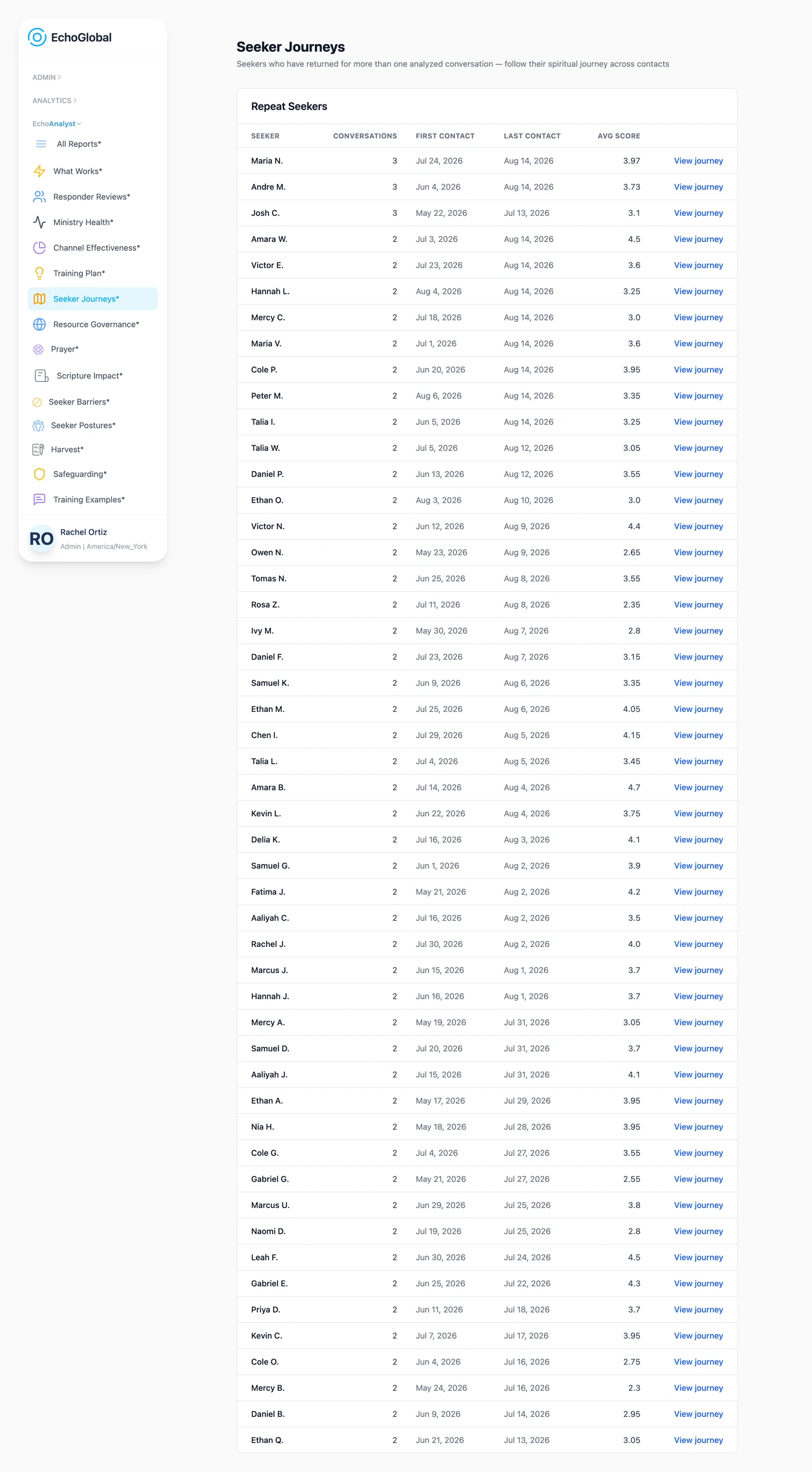
Open EchoAnalyst, then Seeker Journeys. The page opens on Find a Seeker, a search by name or alias. Below it, Recent Repeat Seekers lists everyone who has had more than one analyzed conversation with your ministry in the last 90 days, with how many conversations, when they first and last made contact, and their average conversation score. Those figures cover the 90 days only.
Choose View journey on the seeker you want. A summary is written on request rather than in advance, so you ask for it on the seeker you are actually about to talk to: choose Generate summary on their journey page.
What the summary covers
The whole path rather than the last conversation: what this seeker has been asking about across every conversation, what has already been shared with them, where they were when they first arrived, and where they are now.
What the measurements mean
This is the one report that is about a person rather than a period, so most of its measures are the ones you have already met, narrowed to one seeker.
What is shown
| Measure | What it is | How it is worked out |
|---|---|---|
| Conversations | How many times they have come to you. | Analyzed conversations only, so their first contact here may not be their first contact with you. |
| First and last contact | The span of the relationship. | Dates of the earliest and most recent analyzed conversation. |
| Average score | Quality across their conversations. | The mean whole-conversation score, on the 1–5 scale below. |
| Starting posture | Where they stood at the beginning. | The same seven-rung ladder the Seeker Postures report uses. |
| Movement across the journey | Whether they are moving. | Each conversation's movement, read in sequence rather than as one rate. |
The 1–5 scale
Every skill score in Echo Analyst uses the same five points, and the wording matters. This is not a school grade where 5 is the target.
| Score | What it means | How often |
|---|---|---|
| 1 | Harmful, real harm or a protocol violation, such as missing a crisis or a doctrinal error | Rare |
| 2 | Below standard, a coachable weakness | Uncommon |
| 3 | Met the minimum, acceptable, with clear room to grow | Less common |
| 4 | Doing a good job, the expected baseline for someone doing the work well | Most common |
| 5 | Exceptional, training-example quality, and it requires specific cited evidence | Rare |
4 is the target, not 5. A team averaging 4 is doing the job well. A 5 has to be earned with evidence, so a page full of 5s would be a scoring fault rather than a triumph.
Two rules change how the number comes out. A 1 in any single skill caps the whole conversation's overall score, real harm is not averaged away by nine good things. And three skills return nothing at all when they do not apply: crisis sensitivity when there was no crisis, grace-filled truth when no hard truth was needed, and minors handling when no minor was involved. A blank is "not applicable", never zero.
Spiritual movement
The measure that appears on more Echo Analyst pages than any other. Each analyzed conversation is placed in one of five buckets:
- Significant movement toward God
- Slight movement toward
- No change
- Slight movement away
- Significant movement away
Where a report shows a single movement percentage, it is the share of conversations in the top two buckets, significant plus slight movement toward. "No change" is not counted as positive.
The denominator is conversations where movement was actually assessed, not every conversation in the group. A conversation nobody could read either way is left out rather than counted as no change, so the rate is not quietly deflated by conversations that were never a fair test.
A journey is a real person's conversations with your ministry. Treat it as you would notes from a pastoral conversation. It belongs to the follow-up, not to a group chat.
Reading it honestly
Only analyzed conversations are on the journey, so a seeker's first contact here may not be their first contact with you.
A journey summary is written from a real person's conversations with your ministry. Treat it the way you would treat notes from a pastoral conversation. It belongs to the follow-up, not to a group chat.
A seeker with no analyzed conversations has no journey, and the report will say so rather than showing an empty page.
If it will not generate
A review needs analyzed conversations in the range. Only closed conversations that had enough back-and-forth are analyzed, so a quiet period, or one where most conversations are still open, may not have enough to write about.
The controls for narrowing what a report covers are described in Getting started with Echo Analyst.