Seeker Barriers is an atlas of what your seekers are actually carrying , doubt, hurt, shame, competing belief, and the rest, and, more usefully, whether your team engages each one or steps around it.
The question the report itself names is: What stands between our seekers and God, and is it being addressed?
Running it
Open EchoAnalyst in the left-hand menu, then Seeker Barriers. Set a date range, choose your sources if you want to narrow it, and select Run Report. Nothing is computed until you do.
The controls are the same on every Echo Analyst report. They are described once in Getting started with Echo Analyst.
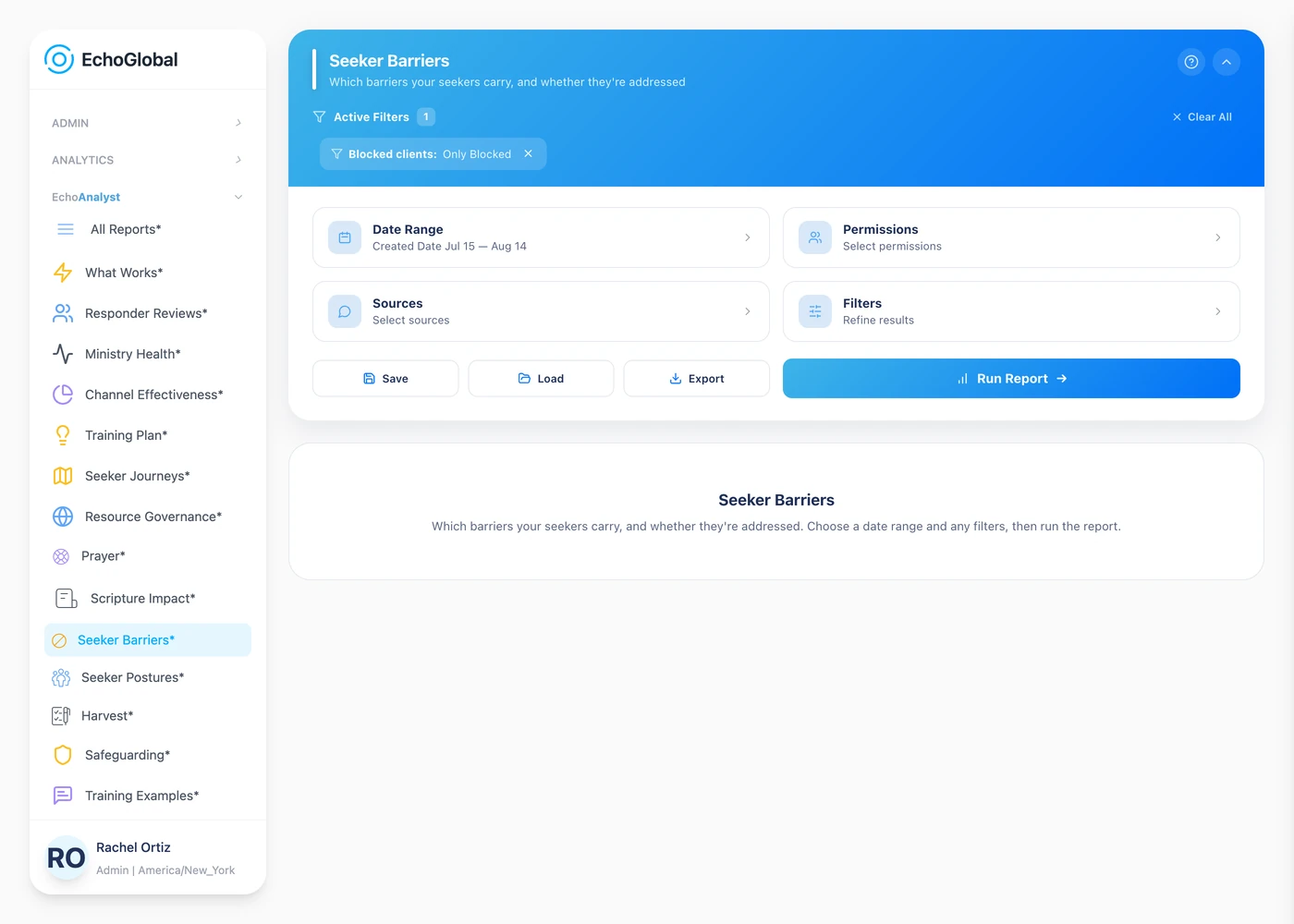
What the page shows
Barriers by frequency and engagement ranks the barrier types by how often they appear, and shows for each one how often a responder addressed it and what movement looked like when they did.
What the barriers sound like is the training half: seekers' own words, so a responder can recognize a barrier when it arrives rather than learning the category name.
Note that the headline counts conversations that named any barrier, while the frequency table counts occurrences, one conversation can name several. The two numbers are answering different questions.
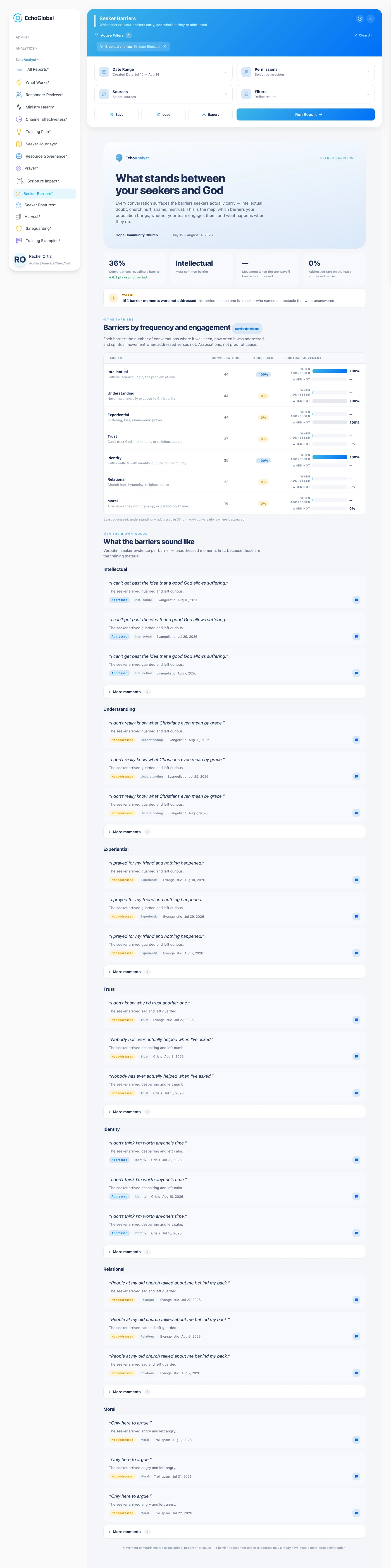
The report itself opens with a Definitions section carrying the same terms in short form, so you can check a word without leaving the page.
What the measurements mean
A barrier is what stands between a seeker and openness to God. There are seven, and they are fixed categories rather than free text.
| Barrier | What it covers |
|---|---|
| Intellectual | Faith versus science, logic, the problem of evil |
| Experiential | Suffering, loss, unanswered prayer |
| Relational | Church hurt, hypocrisy, religious abuse |
| Identity | Faith conflicts with identity, culture or community |
| Moral | A behavior they will not give up, or paralyzing shame |
| Trust | Cannot trust God, institutions, or religious people |
| Understanding | Never meaningfully exposed to Christianity |
The measures
| Measure | What it is | How it is worked out |
|---|---|---|
| Occurrences | How often a barrier appeared. | Counts barriers, not conversations, one conversation can name several. |
| Conversations revealing a barrier | The headline tile. | Counts conversations that named any barrier at all. A different denominator from the table above it. |
| Addressed | Whether the responder engaged it. | The analysis recorded the barrier as addressed rather than passed over. |
| Movement when addressed | The payoff. | Movement rate in conversations where it was addressed, against those where it was not. |
Spiritual movement
The measure that appears on more Echo Analyst pages than any other. Each analyzed conversation is placed in one of five buckets:
- Significant movement toward God
- Slight movement toward
- No change
- Slight movement away
- Significant movement away
Where a report shows a single movement percentage, it is the share of conversations in the top two buckets, significant plus slight movement toward. "No change" is not counted as positive.
The denominator is conversations where movement was actually assessed, not every conversation in the group. A conversation nobody could read either way is left out rather than counted as no change, so the rate is not quietly deflated by conversations that were never a fair test.
The trap on this page
A barrier a responder chose to address may already have been the more open conversation. The engagement gap can reflect which conversations felt approachable as much as what addressing the barrier achieved.
A barrier needs 5 occurrences before it can headline, and 3 addressed conversations before its comparison can headline or be called out.
How the percentages are worked out
Three habits run through every number on this page, and they explain most of the surprises.
- Rates are per measured conversation, not per conversation. Each measure counts only the conversations where that thing was assessed.
- An empty sample gives a blank, not a zero. Where you see "—", nothing was measured. A confident 0% over no conversations would be a false statement, so the report declines to make it.
- Percentages are never averaged together. When groups are combined, the underlying counts are added and the rate is recomputed. Otherwise a rare group of three conversations would weigh as heavily as a common one of three hundred.
Why comparisons are not proof
Everything that compares one group against another here is an association. The report says so in its own words, and it is not a disclaimer to skip: if your team tends to do something in the conversations that were already going well, that practice will appear to cause the result.
The honest way to use it: treat a gap as a reason to try something deliberately, then watch whether the numbers follow.
Reading it honestly
Everything comparing one group against another on this page is an association, not proof of cause. The report says so in its own words, and it matters: if your team tends to do something in the conversations that were already going well, it will look like that practice caused the result.
A barrier a responder chose to address may already have been the more open conversation. That is the specific trap on this page: the engagement gap can reflect which conversations felt approachable as much as what addressing the barrier achieved.
A barrier needs 5 occurrences before it can headline, and at least 3 addressed conversations before its engagement comparison can headline or be called out.
If it comes back empty
Two things cause this, and neither means the report is broken.
The Sources filter remembers what you last chose. A selection made months ago can exclude everything you have added since. Open Sources, check what is ticked, and run it again.
Only closed conversations are analyzed. A conversation that is still open, or that was abandoned before your team replied, carries no analysis and appears in no number here. A busy period can still be a thin one for this report if most of it never closed.