Scripture Impact is about the Word in your conversations: what your team reaches for, what tends to follow, and whether conversations that included Scripture went differently from those that did not.
The question the report itself names is: Which Scriptures move seekers, and how well is the Word being handled?
Running it
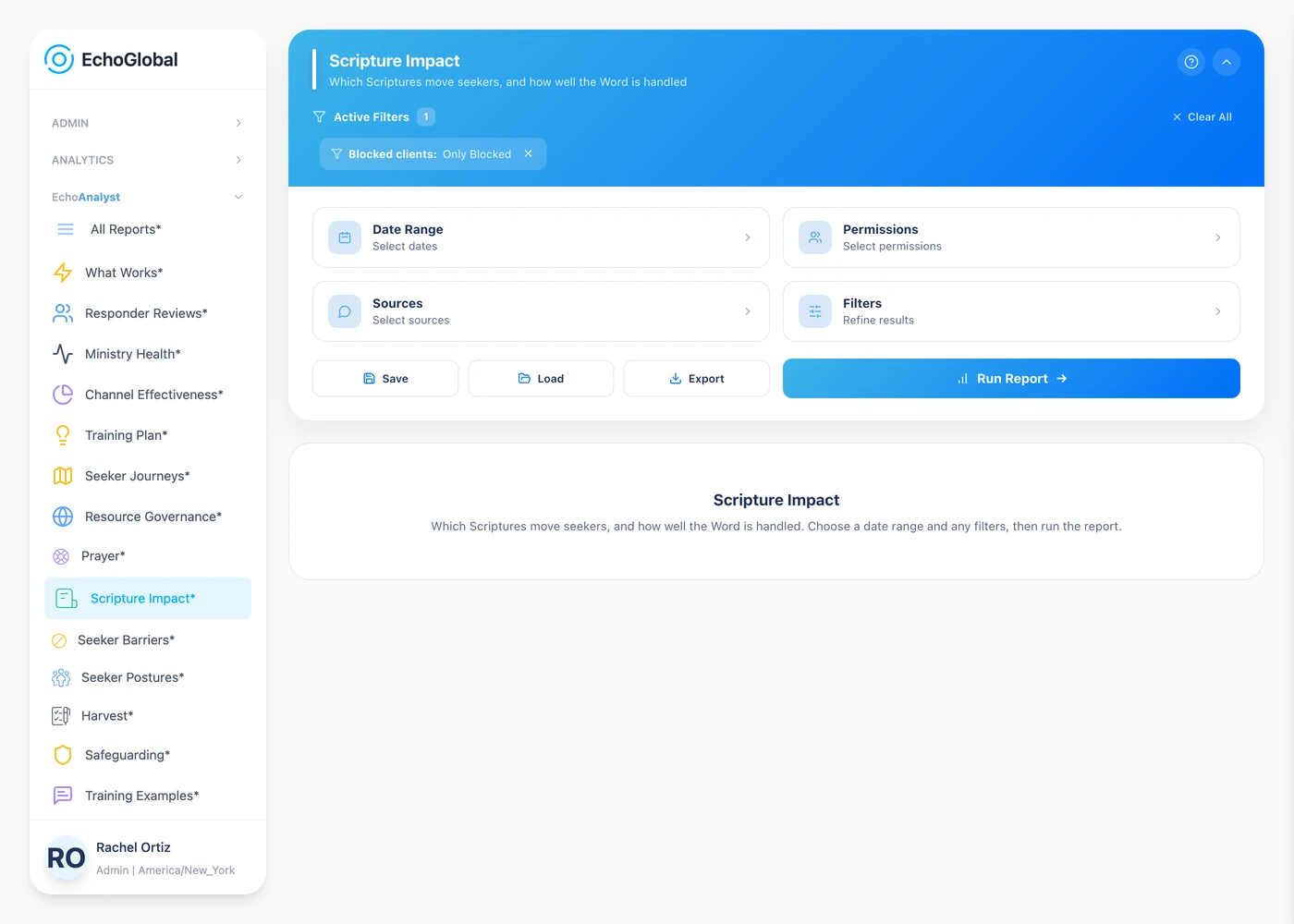
Open EchoAnalyst in the left-hand menu, then Scripture Impact. Set a date range, choose your sources if you want to narrow it, and select Run Report. Nothing is computed until you do.
The controls are the same on every Echo Analyst report. They are described once in Getting started with Echo Analyst.
What the page shows
Most-shared passages and what followed is the main table , each passage, how often it was cited, and what movement looked like around it.
What your team reaches for, by conversation breaks the same thing down by conversation type, which is where habits show up. Spiritual movement, with and without Scripture is the headline comparison, and Conversation quality where Scripture appeared is the score distribution for the citing conversations.
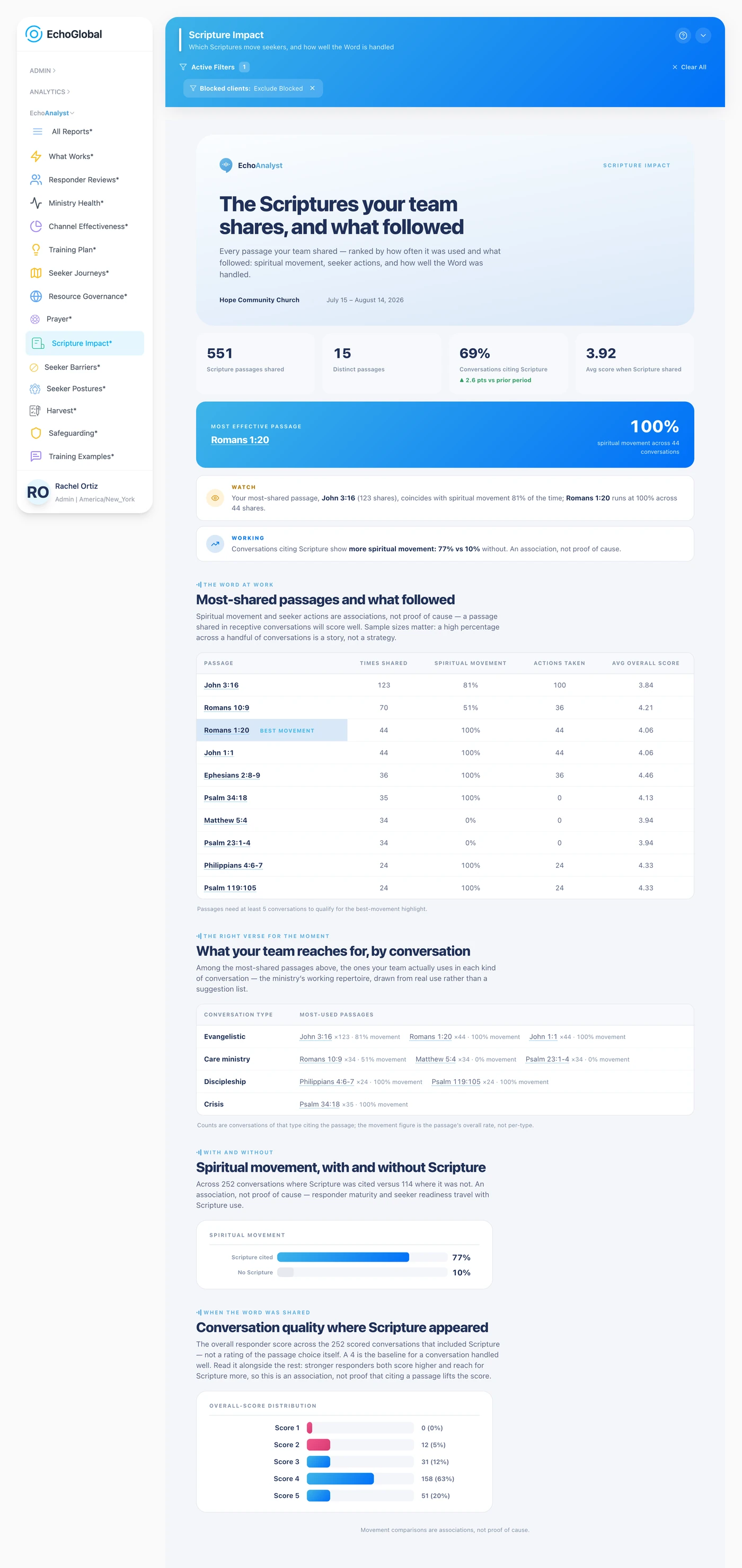
The report itself opens with a Definitions section carrying the same terms in short form, so you can check a word without leaving the page.
What the measurements mean
This report reads a different source from the others, the record of Scripture actually cited in conversations, and joins it to the analyses.
The measures
| Measure | What it is | How it is worked out |
|---|---|---|
| Citations | How often a passage was shared. | Counts citations, so one conversation quoting two passages appears twice. |
| Movement around a passage | What followed when it was shared. | Movement rate in the conversations that cited it. |
| Conversation quality | How the citing conversations scored overall. | The mean whole-conversation score. See the warning below. |
| With and without Scripture | The headline comparison. | Movement in conversations that cited Scripture, against those that did not. |
The 1–5 scale
Every skill score in Echo Analyst uses the same five points, and the wording matters. This is not a school grade where 5 is the target.
| Score | What it means | How often |
|---|---|---|
| 1 | Harmful, real harm or a protocol violation, such as missing a crisis or a doctrinal error | Rare |
| 2 | Below standard, a coachable weakness | Uncommon |
| 3 | Met the minimum, acceptable, with clear room to grow | Less common |
| 4 | Doing a good job, the expected baseline for someone doing the work well | Most common |
| 5 | Exceptional, training-example quality, and it requires specific cited evidence | Rare |
4 is the target, not 5. A team averaging 4 is doing the job well. A 5 has to be earned with evidence, so a page full of 5s would be a scoring fault rather than a triumph.
Two rules change how the number comes out. A 1 in any single skill caps the whole conversation's overall score, real harm is not averaged away by nine good things. And three skills return nothing at all when they do not apply: crisis sensitivity when there was no crisis, grace-filled truth when no hard truth was needed, and minors handling when no minor was involved. A blank is "not applicable", never zero.
Spiritual movement
The measure that appears on more Echo Analyst pages than any other. Each analyzed conversation is placed in one of five buckets:
- Significant movement toward God
- Slight movement toward
- No change
- Slight movement away
- Significant movement away
Where a report shows a single movement percentage, it is the share of conversations in the top two buckets, significant plus slight movement toward. "No change" is not counted as positive.
The denominator is conversations where movement was actually assessed, not every conversation in the group. A conversation nobody could read either way is left out rather than counted as no change, so the rate is not quietly deflated by conversations that were never a fair test.
The quality number is the most misread thing on this page. It is the whole-conversation responder score for conversations that cited Scripture. It is not a judgment of how well the passage was handled. A low score beside a passage means that conversation went poorly overall, not that the verse was misused.
A passage needs 5 conversations with a spiritual-movement evaluation to be highlighted, and a moment 3 uses to be named. Anything under 10 is marked as a small sample on the page.
How the percentages are worked out
Three habits run through every number on this page, and they explain most of the surprises.
- Rates are per measured conversation, not per conversation. Each measure counts only the conversations where that thing was assessed.
- An empty sample gives a blank, not a zero. Where you see "—", nothing was measured. A confident 0% over no conversations would be a false statement, so the report declines to make it.
- Percentages are never averaged together. When groups are combined, the underlying counts are added and the rate is recomputed. Otherwise a rare group of three conversations would weigh as heavily as a common one of three hundred.
Why comparisons are not proof
Everything that compares one group against another here is an association. The report says so in its own words, and it is not a disclaimer to skip: if your team tends to do something in the conversations that were already going well, that practice will appear to cause the result.
The honest way to use it: treat a gap as a reason to try something deliberately, then watch whether the numbers follow.
Reading it honestly
Everything comparing one group against another on this page is an association, not proof of cause. The report says so in its own words, and it matters: if your team tends to do something in the conversations that were already going well, it will look like that practice caused the result.
One thing on this page is routinely misread. The quality numbers are the whole-conversation responder score for conversations that cited Scripture. They are not a judgment of how well the passage itself was handled. A low score next to a passage means that conversation went poorly overall, not that the verse was misused.
A passage needs 5 conversations with a spiritual-movement evaluation to be highlighted, and a moment needs 3 uses before it is named. Anything under 10 is marked as a small sample on the page itself.
If it comes back empty
Two things cause this, and neither means the report is broken.
The Sources filter remembers what you last chose. A selection made months ago can exclude everything you have added since. Open Sources, check what is ticked, and run it again.
Only closed conversations are analyzed. A conversation that is still open, or that was abandoned before your team replied, carries no analysis and appears in no number here. A busy period can still be a thin one for this report if most of it never closed.