Harvest is the follow-up report. It takes every spiritual action a seeker took in the period, a salvation prayer, a rededication, agreeing to read Scripture, asking to be contacted again, and asks what happened next.
The question the report itself names is: What happened to the people who said yes?
Running it
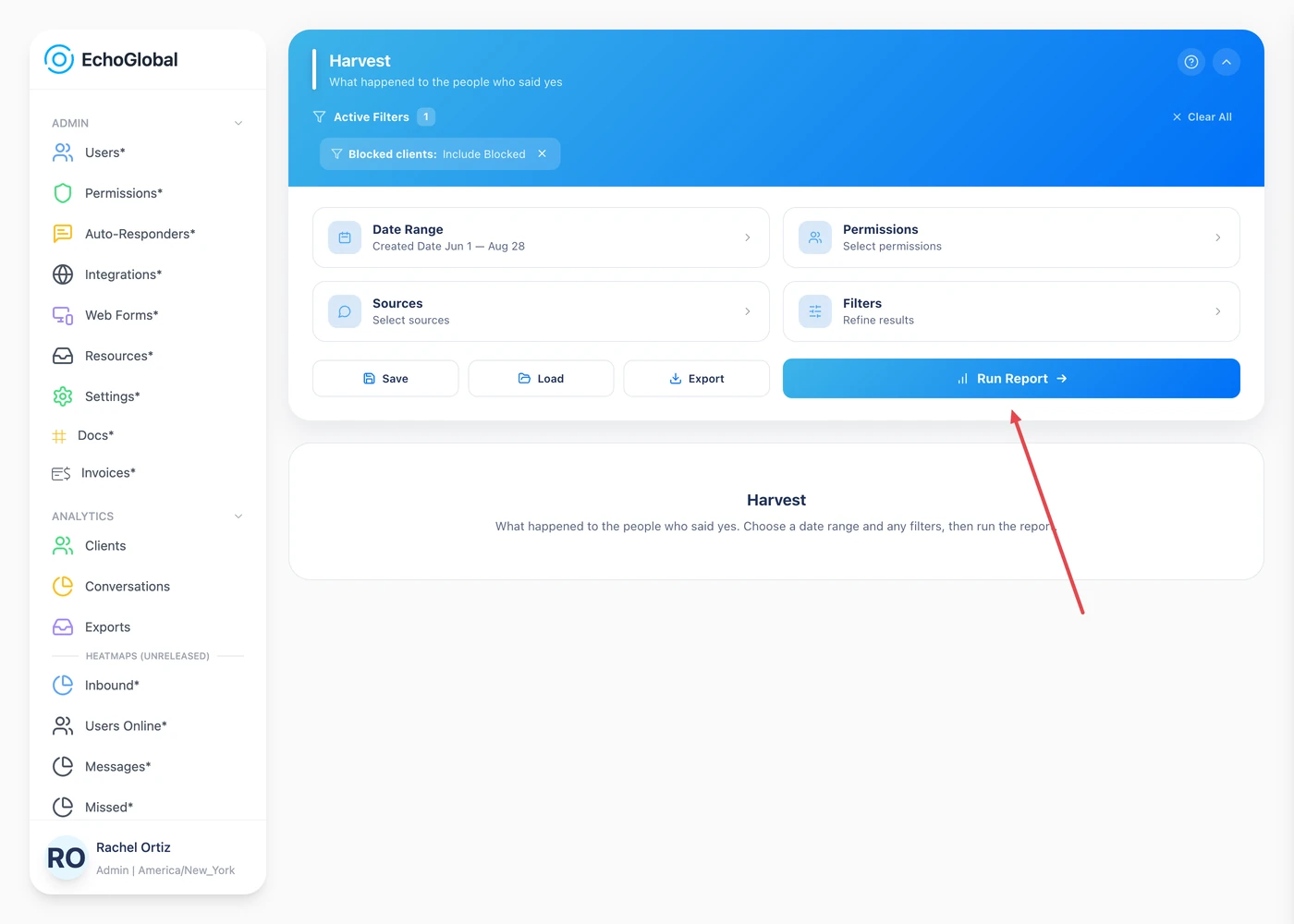
Open EchoAnalyst in the left-hand menu, then Harvest. Set a date range, choose your sources if you want to narrow it, and select Run Report. Nothing is computed until you do.
The controls are the same on every Echo Analyst report. They are described once in Getting started with Echo Analyst.
What the page shows
A funnel across the top: conversations, how many heard the Gospel, how many took an action, how many prayed to receive Christ. Then rates for each step.
Each action, in detail is a table with one row per kind of action: how many, the average closing score, how many needed support beyond your ministry's scope, and how many of those seekers came back.
The follow-up workload is the section to read as a to-do list, actions needing outside support, seekers who asked for follow-up, and actions with a weak close. Every action, reviewable is the log itself, so you can open the conversation behind any number.
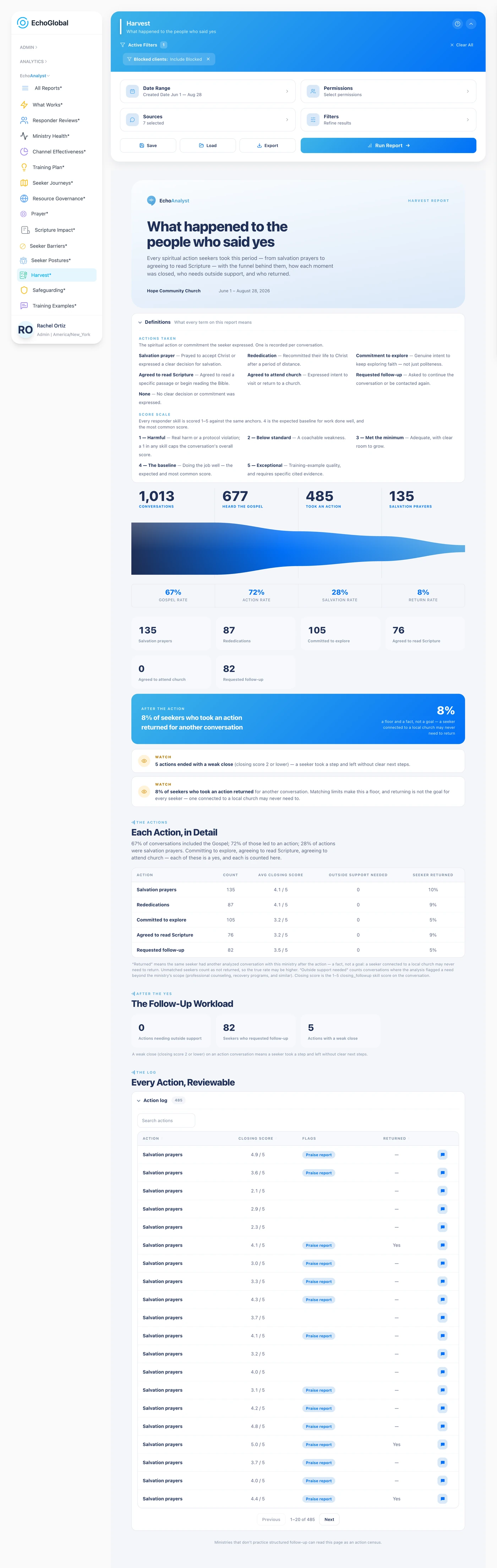
The report itself opens with a Definitions section carrying the same terms in short form, so you can check a word without leaving the page.
What the measurements mean
This report counts actions, so the vocabulary is worth having exactly.
The six actions
| Measure | What it is | How it is worked out |
|---|---|---|
| Salvation prayer | A seeker prayed to receive Christ. | The single most significant action, and the funnel's last stage. |
| Rededication | A believer recommitted their life. | Recorded separately from a first profession. |
| Committed to explore | A genuine intent to keep exploring faith. | More than politeness, a stated intention. |
| Agreed to read Scripture | Agreed to read a passage or begin the Bible. | Counted as an action in its own right. |
| Agreed to attend church | Expressed intent to visit or return to a church. | |
| Requested follow-up | Asked to continue the conversation or be contacted. | This is the one that generates work this week. |
The measures
| Measure | What it is | How it is worked out |
|---|---|---|
| Gospel rate | How much of your traffic heard the Gospel. | Conversations where at least one Gospel element was presented, over all conversations. |
| Action rate | How often hearing led to a step. | Conversations with any of the six actions, over those where the Gospel was shared. |
| Salvation rate | How many of the actions were professions. | Salvation prayers over all actions. |
| Closing score | How well the conversation ended. | The closing and follow-up skill, on the 1–5 scale below. |
| Weak close | Moved, then left without next steps. | A closing score of 2.0 or lower on a conversation where the seeker took a step. |
| Return rate | Seekers who came back after acting. | The same seeker had another analyzed conversation afterwards. |
The 1–5 scale
Every skill score in Echo Analyst uses the same five points, and the wording matters. This is not a school grade where 5 is the target.
| Score | What it means | How often |
|---|---|---|
| 1 | Harmful, real harm or a protocol violation, such as missing a crisis or a doctrinal error | Rare |
| 2 | Below standard, a coachable weakness | Uncommon |
| 3 | Met the minimum, acceptable, with clear room to grow | Less common |
| 4 | Doing a good job, the expected baseline for someone doing the work well | Most common |
| 5 | Exceptional, training-example quality, and it requires specific cited evidence | Rare |
4 is the target, not 5. A team averaging 4 is doing the job well. A 5 has to be earned with evidence, so a page full of 5s would be a scoring fault rather than a triumph.
Two rules change how the number comes out. A 1 in any single skill caps the whole conversation's overall score, real harm is not averaged away by nine good things. And three skills return nothing at all when they do not apply: crisis sensitivity when there was no crisis, grace-filled truth when no hard truth was needed, and minors handling when no minor was involved. A blank is "not applicable", never zero.
"Returned" is a fact, not a goal, and it is a floor. A seeker connected to a local church may never need to come back, and seekers your matching limits never reunited count as not returned, so the true rate is likely higher than the one shown.
The return rate is only worth reading at or above 10 actions; the follow-up insight at or above 5.
How the percentages are worked out
Three habits run through every number on this page, and they explain most of the surprises.
- Rates are per measured conversation, not per conversation. Each measure counts only the conversations where that thing was assessed.
- An empty sample gives a blank, not a zero. Where you see "—", nothing was measured. A confident 0% over no conversations would be a false statement, so the report declines to make it.
- Percentages are never averaged together. When groups are combined, the underlying counts are added and the rate is recomputed. Otherwise a rare group of three conversations would weigh as heavily as a common one of three hundred.
Reading it honestly
"Returned" means the same seeker had another analyzed conversation with your ministry after the action. It is a fact, not a goal, a seeker connected to a local church may never need to come back, and seekers your matching limits never reunited count as not returned. The true rate is likely higher than the one shown.
A weak close is a closing score of 2 or lower on a conversation where the seeker took a step: they moved, and then left without clear next steps. That is the section worth acting on this week.
The return rate is only worth a sentence at or above 10 actions, and the follow-up insight at or above 5.
If it comes back empty
Two things cause this, and neither means the report is broken.
The Sources filter remembers what you last chose. A selection made months ago can exclude everything you have added since. Open Sources, check what is ticked, and run it again.
Only closed conversations are analyzed. A conversation that is still open, or that was abandoned before your team replied, carries no analysis and appears in no number here. A busy period can still be a thin one for this report if most of it never closed.